
Sugar Substitutes and Blood Sugar: Do Artificial Sweeteners Cause Spikes?
Artificial sweeteners, sugar alcohols, and natural alternatives compared for blood sugar impact. CGM evidence, the Suez et al. microbiome study, and allulose's glucose-lowering potential.
Three Categories of Sugar Substitutes
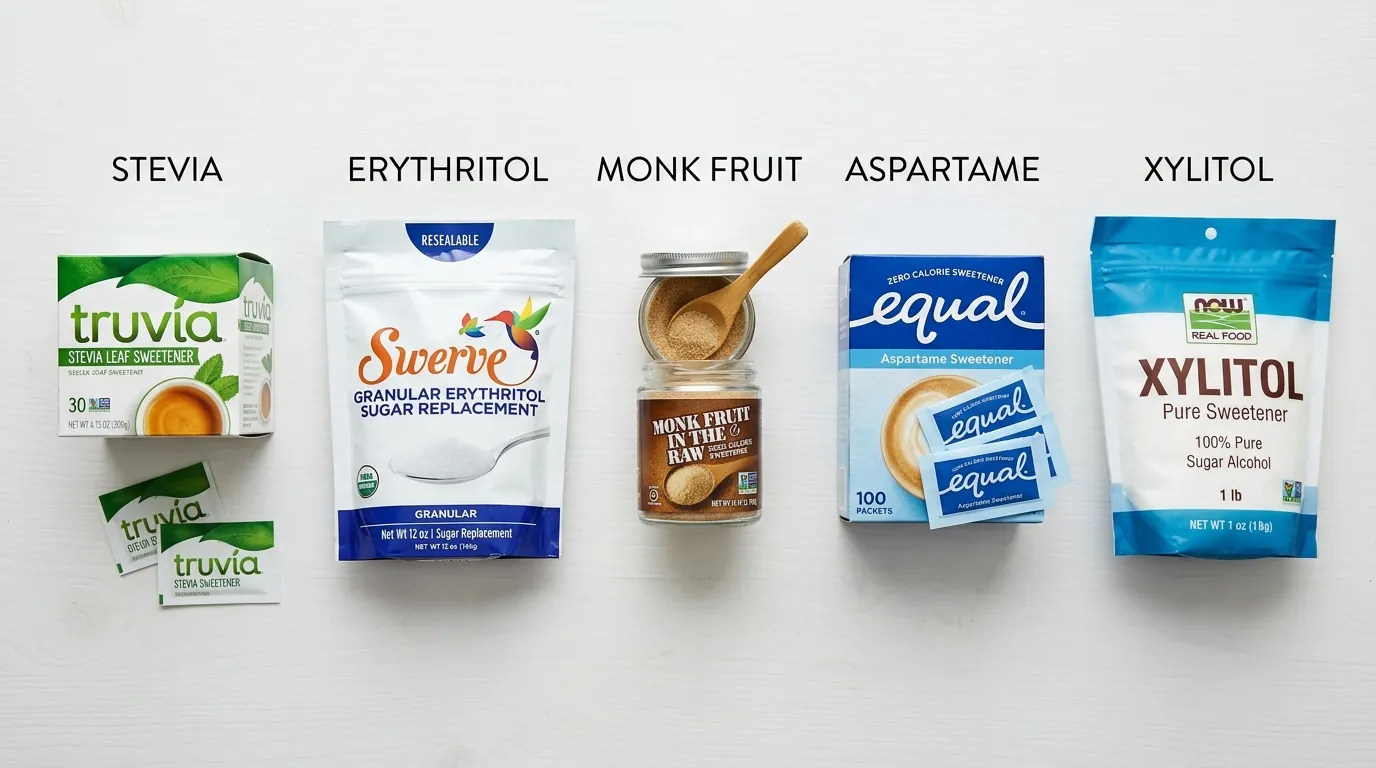
Sugar substitutes fall into three distinct categories with fundamentally different effects on blood glucose. Artificial (non-nutritive) sweeteners include aspartame (Equal), sucralose (Splenda), saccharin (Sweet'N Low), and acesulfame potassium (Ace-K). These provide zero calories and contain no carbohydrate — they pass through the body without being metabolized into glucose. Sugar alcohols (polyols) include erythritol, xylitol, sorbitol, maltitol, and isomalt. These are partially absorbed and metabolized, producing a reduced but non-zero glycemic response — their impact ranges from 0% (erythritol) to 75% (maltitol) of the glucose response produced by an equivalent amount of sugar. Natural high-intensity sweeteners include stevia (from the Stevia rebaudiana plant), monk fruit (luo han guo extract), and allulose (a rare sugar found naturally in figs, raisins, and wheat). Stevia and monk fruit produce zero glucose response. Allulose is unique: it is absorbed but not metabolized, is excreted in urine, and emerging evidence suggests it may actually lower postmeal glucose — the only sweetener with this property.
CGM Evidence: Direct Glucose Impact of Each Sweetener
CGM data provides definitive answers about the direct glucose impact of each sweetener category. Aspartame, sucralose, saccharin, stevia, and monk fruit produce no measurable glucose spike on CGM when consumed alone — a packet of Splenda in coffee or a stevia-sweetened beverage does not raise blood sugar. Erythritol (GI 0) is fully absorbed but not metabolized, producing zero glucose response and zero insulin response on CGM data. Xylitol (GI 7) produces a minimal glucose rise of 5 to 10 mg/dL per tablespoon equivalent. Sorbitol (GI 9) produces a slightly larger but still modest glucose response. Maltitol (GI 36) is the most glycemically impactful sugar alcohol and is the most commonly used in "sugar-free" candy and chocolate — CGM data shows that maltitol-sweetened products can produce glucose spikes of 30 to 50 mg/dL, which surprises consumers who assume "sugar-free" means "no glucose impact." Allulose (GI 0) produces no glucose spike and a 2023 meta-analysis in Nutrients (Hayashi et al.) analyzing 15 clinical trials found that 5 to 10 grams of allulose consumed with a meal reduced the postmeal glucose spike by 10 to 20% — making it the only sweetener that actively lowers blood sugar.
The Microbiome Controversy: Saccharin and Glucose Tolerance
A landmark 2014 study by Suez et al. published in Nature challenged the assumption that non-nutritive sweeteners are metabolically inert. The researchers fed mice saccharin at doses equivalent to the FDA's acceptable daily intake and observed significant glucose intolerance within 11 weeks — the saccharin-fed mice had higher blood glucose after a glucose tolerance test than control mice. Fecal transplant from saccharin-fed mice to germ-free mice replicated the glucose intolerance, establishing the gut microbiome as the mediating mechanism. The researchers then conducted a small human trial (7 participants) and found that 4 of 7 developed worsened glucose tolerance after 1 week of high-dose saccharin consumption, with the 4 "responders" showing distinct microbiome shifts. A 2022 follow-up by the same group (published in Cell) expanded the human trial and found that saccharin and sucralose — but not aspartame or stevia — altered gut microbiome composition and impaired glucose tolerance in some individuals over 2 weeks. These findings suggest that while artificial sweeteners do not directly raise blood glucose, some may indirectly worsen glucose metabolism through microbiome disruption when consumed regularly at high doses. CGM monitoring over weeks can detect this gradual shift as a trend of increasing postmeal glucose responses.
Best Sweetener Choices for Blood Sugar Management
Based on the combined evidence from CGM data, clinical trials, and microbiome research, the optimal sweetener choices for blood sugar management — ranked from most to least favorable — are: First, allulose, which produces zero glucose spike and may actively reduce postmeal glucose by 10 to 20% when consumed with carbohydrate-containing meals. It tastes and behaves similarly to sugar in cooking, with 70% of the sweetness and only 0.4 calories per gram. Second, erythritol (GI 0, 0 calories, 70% as sweet as sugar), which produces zero glucose or insulin response and has no documented microbiome effects at normal consumption levels. Third, stevia and monk fruit, which produce zero glucose response and have favorable safety profiles. Fourth, xylitol (GI 7), which produces a minimal glucose response and has documented dental health benefits. Fifth, sucralose and aspartame are effective for zero-glucose sweetening but carry some microbiome uncertainty at high chronic doses based on the Suez et al. research. Maltitol and sorbitol should be consumed cautiously, as both produce measurable glucose responses that can be significant in large amounts. The safest approach is to moderate total sweetener intake regardless of type and use CGM data to verify your personal glucose response to any product labeled "sugar-free."