
How Food Affects Blood Sugar: Nutrition, Glycemic Index, and CGM-Verified Glucose Responses
Every meal triggers a glucose response that a continuous glucose monitor can measure in real time. This guide covers the science of how food raises blood sugar, ranks 80+ common foods by glycemic index, explains why individual responses vary by up to 4x, and shows how CGM data reveals patterns that fingerstick testing misses entirely.
How Food Affects Blood Sugar: The Basics
Blood sugar (blood glucose) is the concentration of glucose circulating in the bloodstream, measured in milligrams per deciliter (mg/dL). Every food that contains carbohydrates — and to a lesser extent, protein — is broken down during digestion into glucose molecules that enter the blood through the small intestine. This process begins within 15 minutes of eating and typically produces a measurable glucose peak 30 to 60 minutesafter the first bite, depending on the food's composition, form, and fiber content.
In a person with normal glucose metabolism, fasting blood sugar sits between 70 and 99 mg/dL. After a meal, glucose rises to a peak — ideally staying below 140 mg/dL — and the pancreas releases insulin to shuttle glucose into muscle, liver, and fat cells. Within 2 to 3 hours, blood sugar returns to the fasting range. A continuous glucose monitor captures this entire curve at 5-minute intervals, producing 288 readings per day that reveal exactly how each meal, snack, and beverage affects your blood sugar over time.
The size of the glucose spike matters. A 2018 study published in Diabetes Care found that postmeal glucose excursions exceeding 140 mg/dL — even in people with normal A1C levels — were associated with a 26% increase in cardiovascular event risk over a 5.5-year follow-up period compared to individuals whose postmeal glucose stayed below 120 mg/dL. Repeated high spikes also increase oxidative stress, promote endothelial dysfunction, and accelerate glycation of proteins — the same process measured by the A1C test. Understanding which foods drive large spikes and which maintain stable glucose is the foundation of glucose-aware nutrition.
Glycemic Index vs Glycemic Load: Two Metrics, Different Purposes
Glycemic index (GI) is a 0-to-100 scale that ranks carbohydrate-containing foods by how rapidly they raise blood glucose relative to pure glucose (GI = 100). Researchers developed the GI system in 1981 at the University of Toronto (Jenkins et al.), and it remains the most widely referenced food-glucose classification. Foods are categorized as low GI (55 or below), medium GI (56 to 69), or high GI (70 or above). To measure a food's GI, 10 healthy subjects consume a portion containing 50 grams of available carbohydrate, and their blood glucose is tracked for 2 hours. The area under the glucose curve (AUC) is compared to the AUC produced by 50 grams of pure glucose, and the ratio becomes the GI value.
The critical limitation of GI is that it ignores portion size. Glycemic load (GL) corrects this by incorporating the actual grams of carbohydrate in a typical serving. The formula is GL = (GI x net carbs per serving) / 100. GL values are categorized as low (below 10), medium (11 to 19), and high (20 or above). Watermelon demonstrates why this distinction matters: its GI is 72 (high), but a 120-gram serving contains only 6 grams of available carbohydrate, producing a GL of just 4 (low). In practice, eating a normal serving of watermelon raises blood sugar minimally despite its high GI classification. Similarly, carrots have a GI of 71 but a GL of only 6 per serving — making them a perfectly stable food for blood sugar management.
For practical meal planning, GL is the more useful metric. A meal with a total GL below 10 per serving typically keeps postmeal glucose well under 140 mg/dL in most individuals. Research by Brand-Miller et al. (2003, American Journal of Clinical Nutrition) demonstrated that diets emphasizing low-GL foods reduced A1C by 0.5% over 12 weeks compared to high-GL diets with identical calorie counts, confirming that the type and concentration of carbohydrate matters independently of total energy intake. For a complete ranking of foods by both GI and GL, see the glycemic index guide and glycemic load guide.
The Three Macronutrients and Their Effects on Blood Sugar
Carbohydrates: The Primary Driver of Glucose
Carbohydrates raise blood sugar more than any other macronutrient — approximately 90-100% of digestible carbohydrate converts to blood glucose within 1 to 2 hours of consumption. The speed and magnitude of this conversion depends on the carbohydrate's structure: monosaccharides (glucose, fructose) and disaccharides (sucrose, lactose) are absorbed rapidly through the small intestine, while polysaccharides (starch, glycogen) must be enzymatically broken into individual glucose molecules first. A slice of white bread (25g carbs, GI 75) produces a glucose spike of 40 to 80 mg/dL in most people, peaking at 30 to 45 minutes. An equivalent caloric portion of lentils (20g carbs, GI 32) produces a rise of only 15 to 30 mg/dL, peaking at 60 to 90 minutes. Fiber — a non-digestible carbohydrate — does not raise blood glucose and actively slows the absorption of other carbohydrates in the same meal. The American Diabetes Association recommends individualized carbohydrate intake rather than a fixed percentage, with most adults consuming 45 to 65% of total calories from carbohydrates. For a detailed breakdown, see the carbohydrates and blood sugar guide.
Protein: Moderate, Delayed Effect
Protein produces a smaller, slower glucose response than carbohydrates — approximately 50% of ingested protein can be converted to glucose through a process called gluconeogenesis, but this conversion occurs over 3 to 5 hours rather than 1 to 2 hours. A high-protein meal (40g protein, minimal carbs) typically raises blood glucose by 10 to 30 mg/dL with a peak at 2 to 4 hours — a pattern that is invisible on fingerstick testing but clearly visible on continuous glucose monitor data. More importantly, protein stimulates insulin secretion through a non-glucose pathway (incretin hormones GIP and GLP-1), which helps stabilize blood sugar when protein is eaten alongside carbohydrates. Research published in Diabetes Care (Shukla et al., 2015) showed that consuming 30 grams of protein before carbohydrates reduced the postmeal glucose spike by 29% compared to eating carbohydrates first. For optimal timing strategies, see the protein and blood sugar guide.
Fat: Slows Absorption, Complicates the Curve
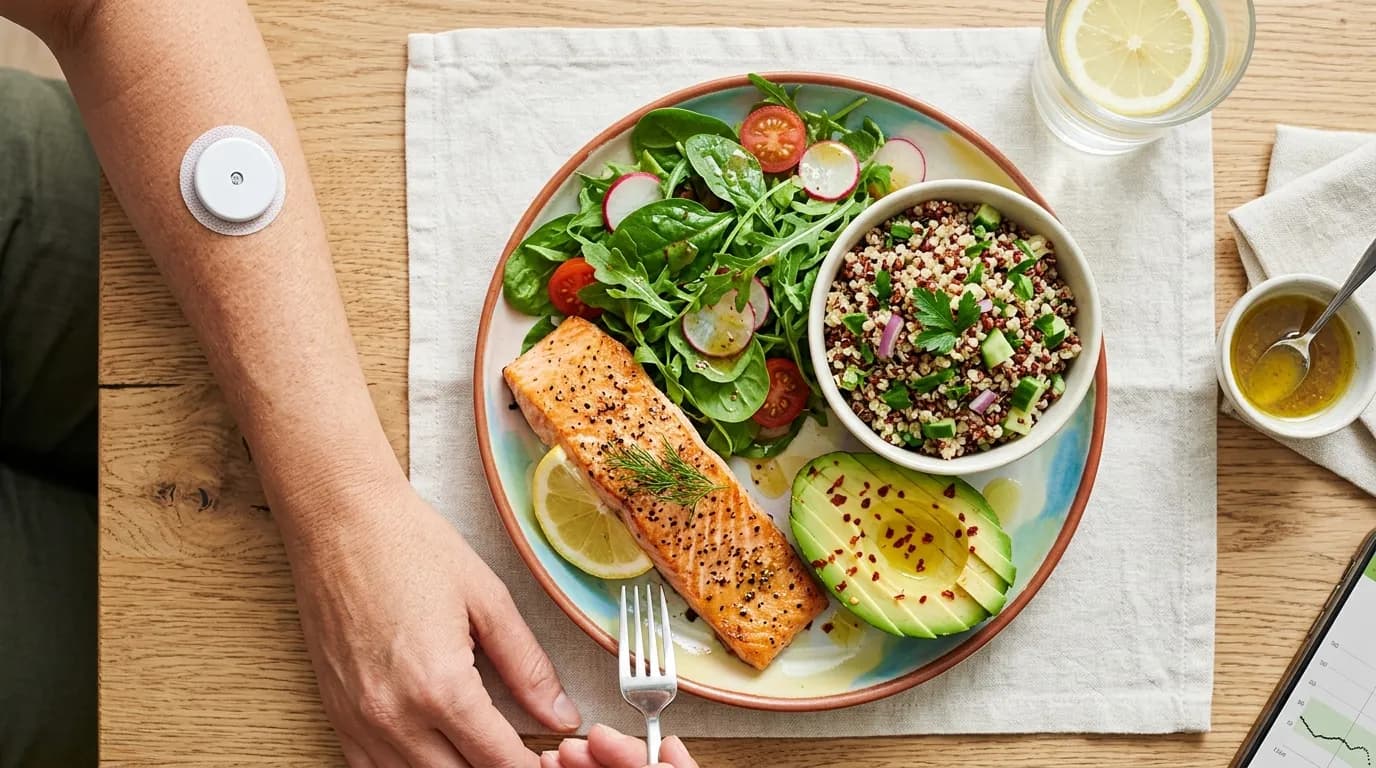
Dietary fat does not raise blood sugar directly — fat contains no glucose and is not converted to glucose through normal metabolic pathways. However, fat profoundly affects the glucose response to carbohydrates eaten at the same meal. Fat slows gastric emptying, which delays the delivery of carbohydrates to the small intestine and spreads glucose absorption over a longer window. Adding 15 to 20 grams of fat (e.g., a tablespoon of olive oil, half an avocado, or a handful of almonds) to a carbohydrate-rich meal can reduce the glucose spike by 20 to 35% while extending the elevation period from 2 hours to 3 to 4 hours. This creates a lower, wider glucose curve rather than a tall, narrow spike — a pattern that is metabolically preferable because it reduces peak insulin demand. CGM data after a high-fat, high-carb meal (such as pizza) often shows a delayed, prolonged glucose elevation lasting 4 to 6 hours, which is missed entirely by a single 2-hour post-meal fingerstick.
Why Individual Glucose Responses Vary by Up to 4x
The same food produces dramatically different glucose responses in different people. A landmark 2015 study by Zeevi et al. at the Weizmann Institute of Science (published in Cell) monitored 800 participants over one week using continuous glucose monitors, standardized meals, and comprehensive stool sampling for gut microbiome analysis. The researchers recorded over 46,898 meals and found that postmeal glucose responses to identical foods varied by a factor of 2x to 4xbetween individuals. One participant's glucose barely moved after eating a cookie, while another participant's glucose spiked by 80 mg/dL from the same cookie. Bread — universally assumed to spike blood sugar — produced responses ranging from nearly flat to a 94 mg/dL spike across the cohort.
The strongest predictor of individual glucose response was gut microbiome composition — specifically the ratio of certain bacterial species in the large intestine. Participants with higher Prevotella-to-Bacteroides ratios showed different glucose responses to fiber-rich foods than those with the inverse ratio. Other significant factors included body fat percentage (higher adiposity correlated with larger spikes), habitual dietary patterns (regular high-fiber eaters showed blunted responses to carbohydrates), sleep duration (participants sleeping fewer than 6 hours showed 15-20% higher postmeal glucose), and recent physical activity (exercise within 3 hours of a meal reduced spike magnitude by 10-25%).
This research has a direct implication for nutrition guidance: population-average glycemic index values are unreliable for individual meal planning. A food listed as low-GI in a reference table may produce a high-GI response in your body, and vice versa. The only way to determine your personal glucose response to specific foods is to measure it directly — and a continuous glucose monitor is currently the only consumer tool that provides this data at the resolution needed (288+ readings per day) to capture the full postmeal curve. The best CGMs ranked for 2026 all provide the 5-minute data resolution needed for food response testing, with over-the-counter options starting at $49 per month. CGM subscription services like Nutrisense and Levels have built their entire value proposition around this personalized approach to nutrition.
What CGM Data Reveals About Food That Fingersticks Cannot
A continuous glucose monitor captures the complete glucose response to every meal — not just a single reading at one point in time. A fingerstick blood glucose test taken 2 hours after eating shows whether glucose has returned to baseline but misses everything in between: the spike height, the time to peak, the rate of rise, the duration of elevation, and the recovery pattern. CGM data, with 288 readings per day at 5-minute intervals, reveals the full postmeal curve and exposes 4 critical metrics that fingerstick testing cannot detect.
Spike magnitude is the difference between your pre-meal baseline and the peak glucose value. A spike of 30 mg/dL from a pre-meal baseline of 90 mg/dL (peaking at 120 mg/dL) is metabolically benign. A spike of 80 mg/dL from the same baseline (peaking at 170 mg/dL) triggers a significantly larger insulin response and promotes inflammatory pathways. Time to peak varies from 15 minutes (sugary drinks) to 90 minutes (high-fat meals), and shorter peak times generally indicate faster-absorbing carbohydrates. Duration of elevation — how long glucose stays above your pre-meal baseline — matters because prolonged elevation above 140 mg/dL contributes to glycation and oxidative stress. Recovery speed reveals how effectively your insulin response clears glucose; a slow recovery (more than 3 hours to return to baseline) can indicate early insulin resistance even when fasting glucose and A1C are normal.
CGM data also reveals compounding effects across meals. If breakfast produces a glucose spike that hasn't fully resolved by lunch, the lunch spike stacks on top of the residual elevation — producing a higher peak than the same lunch would produce on a flat baseline. This "glucose stacking" pattern is invisible without continuous monitoring and explains why some people experience worsening glucose control as the day progresses. A 2023 study in Diabetologia demonstrated that 67% of adults with normal A1C had at least one CGM-detected glucose excursion above 180 mg/dL per day, primarily after their highest-carbohydrate meal. These hidden spikes are detectable only with a CGM and represent an opportunity for dietary optimization that conventional testing misses entirely. To learn more about interpreting CGM reports, see the CGM glucose reports guide.
6 Meal Composition Strategies for Stable Blood Sugar
How you combine and sequence foods within a meal affects blood sugar as much as what you eat. The following 6 strategies are each supported by clinical research and consistently validated by CGM data.
1. Eat Vegetables First, Then Protein, Then Carbohydrates
A 2015 study by Shukla et al. (Weill Cornell Medical College, published in Diabetes Care) found that eating vegetables and protein before carbohydrates at the same meal reduced the postmeal glucose spike by 29% and the area under the glucose curve by 37%compared to eating carbohydrates first. The fiber and protein slow gastric emptying, so when carbohydrates arrive in the stomach, they enter an already-slowed digestive system. This "food order" strategy requires no changes to what you eat — only the sequence.
2. Add Fat to Carbohydrate-Heavy Meals
Adding 15 to 20 grams of healthy fat — a tablespoon of olive oil, a quarter of an avocado, or 15 almonds — to a carbohydrate-rich meal reduces the glucose spike by 20 to 35% by slowing gastric emptying. A 2006 study in Diabetes Care demonstrated that adding monounsaturated fat to a high-GI meal reduced the 2-hour postmeal glucose by 33% in subjects with type 2 diabetes.
3. Take a 10-to-15-Minute Walk After Meals
Skeletal muscle contraction during walking activates GLUT4 glucose transporters independently of insulin, pulling glucose from the bloodstream into muscle cells. A 2022 meta-analysis in Sports Medicine (Buffey et al.) analyzing 7 randomized controlled trials found that light walking within 30 minutes after eating reduced postmeal glucose peaks by 17 to 24%. The wellness section covers exercise and glucose in more detail.
4. Include Vinegar Before or With Meals
Apple cider vinegar (1 to 2 tablespoons diluted in water) consumed 5 to 10 minutes before a meal reduces the postmeal glucose spike by 20 to 35%. The acetic acid in vinegar inhibits the enzyme alpha-amylase, which slows starch digestion, and also enhances glucose uptake by skeletal muscle. A 2004 study by Johnston et al. (Diabetes Care) found that vinegar before a high-carb meal improved insulin sensitivity by 34% in insulin-resistant subjects.
5. Pair High-GI Foods with Fiber
Adding 5 to 10 grams of soluble fiber to a high-GI food reduces its effective glycemic impact by 25 to 40%. Soluble fiber forms a viscous gel in the stomach and small intestine that physically slows glucose absorption. Practical examples: adding 2 tablespoons of chia seeds to white rice, eating an apple with the skin instead of drinking apple juice, or stirring psyllium husk into oatmeal. See the fiber and blood sugar guide for more strategies.
6. Avoid Liquid Carbohydrates on an Empty Stomach
Liquid carbohydrates — fruit juice, soda, sweetened coffee, smoothies — bypass the mechanical digestion required for solid foods and deliver glucose to the small intestine within 5 to 10 minutes. CGM data consistently shows that a glass of orange juice produces a spike 40 to 60% largerthan eating a whole orange with equivalent sugar content, because the whole fruit's fiber, pulp, and cell structure slow absorption. If you consume liquid carbs, always pair them with protein and fat (e.g., a smoothie with protein powder and nut butter) to blunt the spike.
5 Common Myths About Food and Blood Sugar
Myth 1: All Fruit Is Bad for Blood Sugar
Most whole fruits produce modest glucose responses. Berries (GI 25-40, GL 3-5), apples (GI 36, GL 6), pears (GI 38, GL 4), and cherries (GI 22, GL 3) are among the lowest-impact carbohydrate sources available. The fiber, water content, and polyphenols in whole fruit slow glucose absorption. What spikes blood sugar is fruit juice (stripped of fiber) and dried fruit (concentrated sugar) — not the whole fruit itself. CGM data consistently confirms that a serving of blueberries produces a smaller spike than a slice of white bread despite similar carbohydrate content.
Myth 2: Brown Rice Is Always Better Than White Rice
Brown rice (GI 68) produces a similar glucose response to white rice (GI 73) in many individuals. The 5-point GI difference is modest, and cooking method, variety, and serving size affect the response more than the brown-versus-white distinction. Basmati rice (GI 58) and parboiled rice (GI 38) produce significantly lower glucose responses than either white or brown rice. CGM data reveals that cooling rice after cooking (and eating it cold or reheated) reduces the glucose impact by 10-15% due to retrograde starch formation — a form of resistant starch that is not digested into glucose.
Myth 3: "Sugar-Free" Means No Effect on Blood Sugar
"Sugar-free" products can still raise blood glucose substantially. Many sugar-free foods contain maltitol (GI 36), isomalt (GI 9), or other sugar alcohols that are partially absorbed and converted to glucose. Sugar-free cookies and candy bars often contain significant starch that digests into glucose identically to sugar. The only sweeteners with zero glycemic impact are stevia, monk fruit, erythritol (GI 0), and allulose. CGM data is the definitive way to verify whether a specific "sugar-free" product actually avoids a glucose spike in your body. For a complete breakdown, see the sugar substitutes guide.
Myth 4: You Must Eliminate All Carbs to Control Blood Sugar
Carbohydrate quality and meal composition matter more than total elimination. Extremely low-carb diets (below 50g/day) do minimize glucose spikes but are difficult to sustain long-term and eliminate beneficial fiber and micronutrients found in whole grains, fruits, and legumes. A Mediterranean-style diet — rich in vegetables, legumes, olive oil, fish, and moderate whole grains — produces similar Time in Range results to very-low-carb diets in CGM studies while being more sustainable. A 2020 BMJ meta-analysis of 56 trials found that low-GI diets reduced A1C by 0.31% compared to higher-GI diets, with no additional benefit from restricting total carbohydrate below 130g/day.
Myth 5: Eating Late at Night Is Always Bad for Blood Sugar
The time of day affects glucose response, but late eating is not universally harmful. Insulin sensitivity decreases by 15 to 25% in the evening compared to morning due to circadian rhythms (Poggiogalle et al., 2018, Nutrients), meaning the same meal produces a higher glucose spike at 9 PM than at 9 AM. However, CGM data shows that the composition of the late meal matters more than the timing alone: a protein-and-fat-focused dinner at 8 PM produces a smaller glucose response than a carbohydrate-heavy breakfast at 7 AM. The meal timing guide covers circadian glucose patterns in detail.
Deep Dives: Nutrition and Blood Sugar Topics
Glycemic Index Explained: 80+ Common Foods Ranked by GI Value
Read guide →
Glycemic Load vs Glycemic Index: Which Metric Matters More for Blood Sugar
Read guide →
30 Best Foods for Stable Blood Sugar: Evidence-Based Choices
Read guide →
Foods That Spike Blood Sugar: 20 Surprising High-GI Items to Watch
Read guide →
Carbohydrates and Blood Sugar: Simple vs Complex, Timing, and Amounts
Read guide →
Fiber and Blood Sugar: How Soluble Fiber Slows Glucose Absorption
Read guide →
Protein and Blood Sugar: The Stabilizing Effect and Optimal Timing
Read guide →
Alcohol and Blood Sugar: Effects, Risks, and What CGM Data Shows
Read guide →
Coffee and Blood Sugar: How Caffeine Affects Glucose Response
Read guide →
Sugar Substitutes and Blood Sugar: Do Artificial Sweeteners Cause Spikes?
Read guide →
Meal Timing and Blood Sugar: Why When You Eat Matters as Much as What
Read guide →
Blood Sugar-Friendly Meal Plans: 7-Day Sample Menus with GI Values
Read guide →
When Food Isn't the Problem
Not every glucose spike is caused by what you eat. CGM data frequently reveals blood sugar elevations of 30 to 50 mg/dL triggered by psychological stress and cortisol release, 15 to 25% reductions in insulin sensitivity from a single night of poor sleep (4 hours vs 8 hours), and medication-induced spikes of 40 to 100+ mg/dL from corticosteroids like prednisone. If your CGM shows unexplained glucose elevations despite consistent low-GI meals, the cause may be non-dietary. For a complete breakdown of 9 non-food triggers including stress, sleep, illness, hormones, and the dawn phenomenon, see the blood sugar spikes guide.
Related Resources
- CGM for Wellness: 8 Non-Diabetes Uses — Weight loss, athletic fueling, biohacking, sleep, and stress — how CGM data optimizes health beyond diabetes.
- Nutrition-Focused CGM Services and Coaching Programs — Nutrisense vs Levels vs Signos vs Veri — pricing, dietitian access, and food-scoring features.
- Best CGMs for Food Response Testing — Ranked by accuracy, data density, and app quality for nutrition tracking.
- Blood Sugar Levels Guide — Normal ranges, after-eating targets, A1C correlation, and what your numbers mean.
- CGM Pricing and Monthly Cost Breakdown — Compare device costs from $49 OTC to $300 prescription, plus insurance and discount options.
- Head-to-Head CGM Comparisons — Dexcom G7 vs FreeStyle Libre 3, Stelo vs Lingo, and 12 more side-by-side device matchups.