
Metabolic Health Tests: 12 Lab Values Your Doctor Should Order
12 essential lab tests for metabolic health organized by category: glucose metabolism, lipids, inflammation, and liver function. Normal vs optimal ranges, costs, frequency, and what to ask your doctor.
Why Standard Lab Panels Miss Metabolic Dysfunction
A standard annual physical typically includes a basic metabolic panel (BMP) or comprehensive metabolic panel (CMP) and a lipid panel — a total of 14-20 lab values. These panels were designed to screen for acute medical conditions, not to detect the gradual metabolic deterioration that precedes type 2 diabetes, cardiovascular disease, and metabolic syndrome by 10-20 years. The critical gaps in standard panels are: no fasting insulin (the earliest-changing metabolic marker), no A1C (unless specifically requested or the patient already has a diabetes diagnosis), no hs-CRP (the primary inflammation marker), and no advanced lipid markers like ApoB or triglyceride-to-HDL ratio. A person with a fasting glucose of 95 mg/dL and total cholesterol of 200 mg/dL would receive an "all normal" report from standard panels while potentially harboring a fasting insulin of 22 uIU/mL (severe insulin resistance), an hs-CRP of 4.5 mg/L (high inflammation), and a triglyceride-to-HDL ratio of 5.0 (strongly predictive of cardiovascular events). To detect metabolic dysfunction at its earliest and most reversible stage, 12 specific lab values should be requested in addition to or as part of routine blood work.
Glucose Metabolism Tests: 4 Essential Values
Four tests assess glucose metabolism from different angles, and each reveals information the others miss. (1) Fasting glucose: the standard screening test, drawn after 8-12 hours fasting. Optimal: 72-85 mg/dL. Normal: below 100 mg/dL. Prediabetes: 100-125 mg/dL. Diabetes: 126+ mg/dL on 2 tests. Cost: included in standard BMP/CMP ($15-$30 without insurance). Limitation: fasting glucose is normal for 10-15 years during insulin resistance because the pancreas compensates. (2) A1C (glycated hemoglobin): reflects 2-3 month average glucose. Optimal: below 5.4%. Normal: below 5.7%. Prediabetes: 5.7-6.4%. Diabetes: 6.5%+. Cost: $30-$60. Limitation: affected by hemoglobin variants, anemia, and individual glycation rates. (3) Fasting insulin: the earliest metabolic marker, rising years before glucose becomes abnormal. Optimal: below 8 uIU/mL. Normal: below 12 uIU/mL. Elevated: 12-20 uIU/mL. Insulin resistant: above 20 uIU/mL. Cost: $25-$50. Not included in standard panels — must be specifically requested. (4) Oral glucose tolerance test (OGTT): measures glucose at fasting, 1 hour, and 2 hours after drinking 75g glucose solution. Normal 2-hour value: below 140 mg/dL. Impaired glucose tolerance: 140-199 mg/dL. Diabetes: 200+ mg/dL. Cost: $50-$100. The OGTT is the most sensitive single test for detecting impaired glucose tolerance but is time-consuming (2+ hours in the lab) and rarely ordered in primary care.
Lipid Tests: 5 Values Beyond the Standard Panel
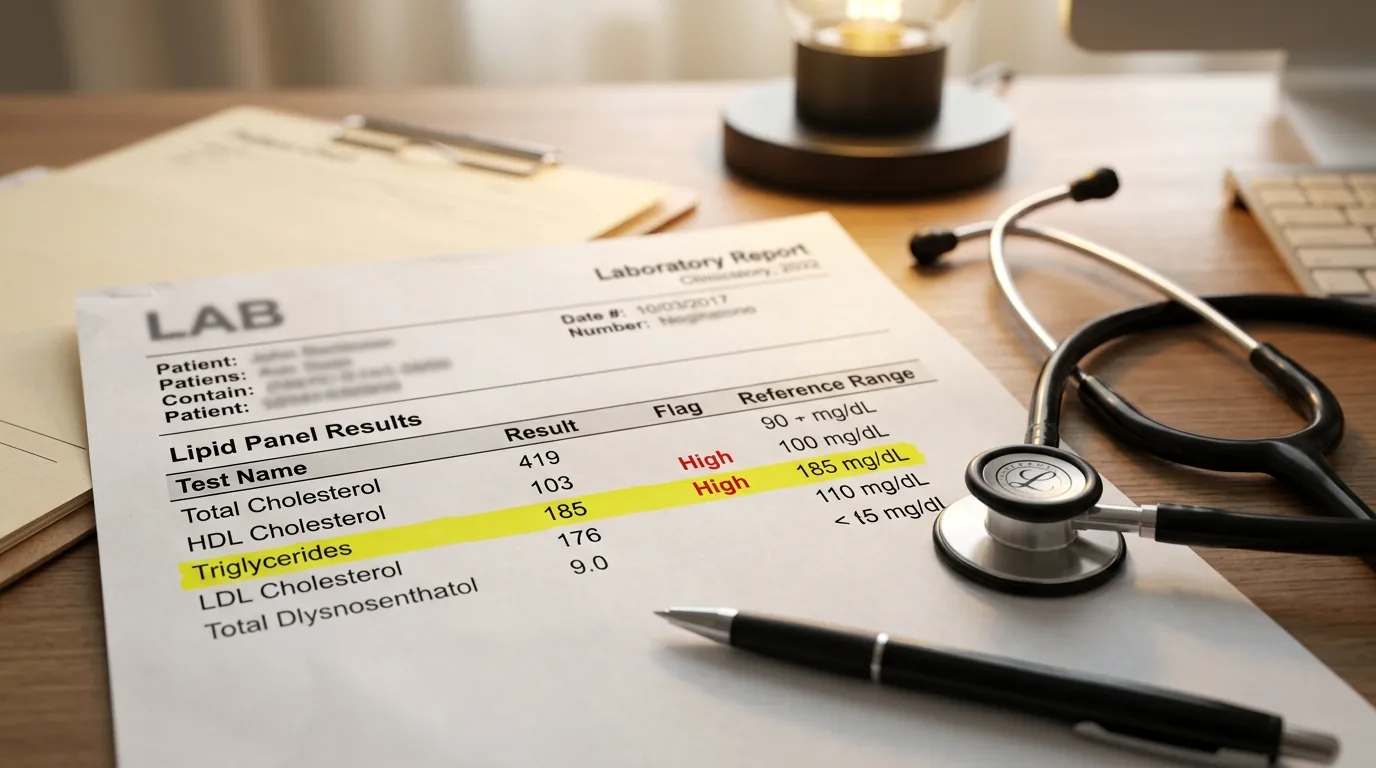
A standard lipid panel reports total cholesterol, LDL, HDL, and triglycerides — 4 values that provide an incomplete cardiovascular risk assessment. Five lipid-related values offer superior predictive power for metabolic health. (1) Triglycerides: a standard panel value, but its significance for metabolic health is underappreciated. Optimal: below 100 mg/dL (not just below 150). The triglyceride-to-HDL ratio is a powerful insulin resistance proxy — a ratio above 3.0 in Caucasian populations or above 2.0 in African American populations predicts insulin resistance with 64% sensitivity and 68% specificity. Cost: included in standard lipid panel. (2) HDL cholesterol: also standard. Optimal: above 60 mg/dL (not just above 40/50). Low HDL is the single best lipid predictor of metabolic syndrome and is often the first lipid marker to deteriorate during insulin resistance. (3) ApoB (apolipoprotein B): measures the number of atherogenic lipoprotein particles in the blood, regardless of their cholesterol content. Optimal: below 80 mg/dL. High risk: above 120 mg/dL. ApoB is a more accurate predictor of cardiovascular events than LDL cholesterol because it counts particles rather than cholesterol mass. Cost: $30-$60. (4) LDL particle number (LDL-P): measures total LDL particles via NMR spectroscopy. Optimal: below 1,000 nmol/L. High risk: above 1,300 nmol/L. Concordant with ApoB in most patients. Cost: $60-$100 (NMR LipoProfile). (5) Small dense LDL percentage: insulin resistance shifts LDL particle size from large/buoyant (less atherogenic) to small/dense (more atherogenic). A small dense LDL percentage above 25% indicates increased cardiovascular risk even when total LDL is normal. Cost: included in NMR LipoProfile.
Inflammation and Liver Markers: 3 Critical Values
Three additional lab values complete the metabolic health picture by measuring inflammation and liver fat. (1) hs-CRP (high-sensitivity C-reactive protein): the most validated systemic inflammation marker. Low cardiovascular risk: below 1.0 mg/L. Moderate risk: 1.0-3.0 mg/L. High risk: above 3.0 mg/L. Values above 10 mg/L suggest acute infection or injury rather than chronic metabolic inflammation and should be retested in 2-3 weeks. The JUPITER trial proved that elevated hs-CRP independently predicts cardiovascular events even with normal LDL cholesterol. Cost: $20-$40. (2) Homocysteine: an amino acid that, when elevated above 12 umol/L, indicates increased cardiovascular risk and potential B-vitamin deficiency (B6, B12, folate). Optimal: below 10 umol/L. High: above 15 umol/L. Elevated homocysteine damages endothelial cells and promotes blood clotting. Cost: $30-$50. (3) ALT (alanine aminotransferase): a liver enzyme that, when elevated, suggests hepatocyte damage — most commonly from non-alcoholic fatty liver disease (NAFLD) in the metabolic syndrome population. Normal: below 25 U/L for women, below 33 U/L for men (these are the updated thresholds from the 2017 ACG Clinical Guideline, which are lower than the traditional lab reference ranges of 35-56 U/L). NAFLD is present in approximately 80% of people with metabolic syndrome and 60% of people with type 2 diabetes. Elevated ALT in the context of metabolic dysfunction should prompt a liver ultrasound to assess hepatic fat content. Cost: included in CMP.
Testing Frequency, Costs, and How to Request
Testing frequency depends on risk level. Low risk (no metabolic markers abnormal, BMI below 25, no family history): comprehensive panel every 2-3 years starting at age 20, annually after age 45. Moderate risk (1-2 abnormal markers, BMI 25-30, or family history of diabetes/heart disease): annually. High risk (metabolic syndrome diagnosed, prediabetes, BMI above 30): every 6 months during active intervention, annually once markers normalize. The total cost for all 12 values ranges from $200-$500 without insurance. With insurance, most tests are covered under preventive care codes when ordered with appropriate diagnoses (metabolic syndrome screening E88.81, obesity E66.01, prediabetes R73.03, family history of diabetes Z83.3). To request these tests efficiently, bring a printed list to your appointment: fasting insulin, fasting glucose, A1C, complete lipid panel, ApoB, hs-CRP, homocysteine, ALT, and fasting status confirmation. Ask for all tests to be drawn from a single fasting blood sample collected between 7-10 AM after a 10-12 hour fast. Avoid intense exercise for 24 hours before the draw, as exercise acutely lowers glucose and insulin while transiently elevating CRP. If your physician will not order specific tests, direct-to-consumer options through Quest, LabCorp, or services like Function Health and InsideTracker allow you to order and pay for any blood test without a physician referral in most U.S. states.