
How Much Does a CGM Cost in 2026? Complete Pricing Guide
A continuous glucose monitor costs between $15 and $400+ per month in 2026, depending on the device, insurance coverage, and whether you choose a prescription CGM, over-the-counter biosensor, or subscription service. The most affordable option is the FreeStyle Libre 3 Plus at $15 to $30 per month with insurance. The most expensive is the Eversense 365 implantable system at $2,000 to $5,000 per annual sensor cycle without insurance coverage. Over-the-counter CGMs that require no prescription cost $49 to $99 per month out of pocket.
CGM pricing in the United States is uniquely complex because the same device can cost 5 to 10 times more without insurance than with it. A Dexcom G7 sensor that costs $20 to $40 per month through insurance runs $250 to $350 per month at retail. This disparity makes insurance status the single largest determinant of CGM cost. Medicare Part B now covers 4 prescription CGMs for qualifying patients with diabetes, while private insurance coverage varies by plan, diagnosis, and prior authorization requirements.
The emergence of over-the-counter CGMs in 2024 created a new pricing tier that bypasses the insurance system entirely. The Dexcom Stelo, Abbott Lingo, and Abbott Libre Rio are purchased directly by consumers at fixed prices of $49 to $99 per month — no prescription, no insurance claim, no copay variability. For the estimated 96 million Americans with prediabetes who do not have a diabetes diagnosis for insurance coverage, OTC CGMs represent the first affordable path to continuous glucose monitoring.
CGM Device Pricing: All Products Compared
Monthly costs for every rated CGM. "Best Value" indicates the lowest total cost for a prescription CGM with insurance coverage.
| CGM Device | With Insurance | Without Insurance | Medicare |
|---|---|---|---|
| Dexcom G7 | $20–$40 per month | $250–$350 per month | ✓ Covered |
| Dexcom G7 15-Day | $20–$40 per month | $250–$350 per month | ✓ Covered |
| FreeStyle Libre 3 PlusBest Value | $15–$30 per month | $75–$150 per month | ✓ Covered |
| Eversense 365 | $150–$350 per month (amortized including implant procedure) | $2,000–$5,000 per annual sensor cycle | — |
| Eversense E3 | $200–$400 per month (amortized including implant procedure) | $1,000–$3,000 per 6-month sensor cycle | — |
| FreeStyle Libre 2 | $15–$30 per month | $75–$150 per month | ✓ Covered |
| Dexcom Stelo | N/A — OTC product not covered by insurance | $49–$99 per month | — |
| Abbott Lingo | N/A — OTC product not covered by insurance | $49 per month | — |
| Medtronic Guardian 4 | $30–$50 per month | $200–$300 per month | ✓ Covered |
| Abbott Libre Rio | N/A — OTC product not covered by insurance | $49 per month | — |
| SIBIONICS CGM | N/A — not yet available in US insurance networks | $30–$60 per month (international pricing) | — |
CGM Subscription Service Pricing
Subscription services include the CGM sensor plus an app with analytics, coaching, or dietitian support.
| Service | Month-to-Month | Annual Plan | Includes |
|---|---|---|---|
| January AI | $288/mo | $149/mo | Sensor + App |
| Veri | $299/mo | $175/mo | Sensor + App |
| Levels Health | $299/mo | $199/mo | Sensor + App |
| Signos | $399/mo | $199/mo | Sensor + App + FDA Cleared |
| Nutrisense | $399/mo | $225/mo | Sensor + App + Dietitian |
CGM Insurance Coverage Overview
Most private insurance plans cover CGMs for patients with type 1 diabetes or insulin-treated type 2 diabetes. Coverage typically requires a prescription from your physician and may involve prior authorization documenting medical necessity. Insurance copays for CGMs generally range from $0 to $75 per month, with the exact amount depending on your plan's durable medical equipment (DME) or pharmacy benefit tier. Some plans cover CGMs under the pharmacy benefit (processed at a retail pharmacy), while others cover them under DME (shipped by a medical supply company).
Coverage for non-insulin type 2 diabetes patients is expanding but inconsistent. Some insurers now cover CGMs for T2D patients with an A1C above 8% or those on sulfonylureas that carry hypoglycemia risk. Gestational diabetes coverage is evaluated on a case-by-case basis, often requiring documentation from a maternal-fetal medicine specialist. Prediabetes is generally not covered because it does not qualify as a diabetes diagnosis under most plan criteria.
Over-the-counter CGMs (Dexcom Stelo, Abbott Lingo, Libre Rio) are not covered by any insurance plan because they are classified as consumer wellness products rather than medical devices for disease treatment. However, some employer wellness programs and Health Savings Accounts (HSA) or Flexible Spending Accounts (FSA) may reimburse OTC CGM purchases.
Read the complete CGM insurance coverage guide →Medicare CGM Coverage Summary
Medicare Part B covers CGMs for patients with diabetes who use insulin and meet specific eligibility criteria. The 4 Medicare-approved CGMs in 2026 are: Dexcom G7, Dexcom G7 15-Day, FreeStyle Libre 3 Plus, and Medtronic Guardian 4. Patient copays under Medicare typically range from $0 to $50 per month, with many Medicare Advantage and supplemental plans covering the copay entirely. Sensors and supplies are obtained through Medicare-contracted durable medical equipment (DME) suppliers.
To qualify, patients must have a diabetes diagnosis with documentation of insulin therapy, obtain a prescription from their treating physician, and receive supplies from a Medicare-contracted DME provider. The Eversense E3 and Eversense 365 implantable CGMs are not currently Medicare-approved, and over-the-counter CGMs are ineligible for Medicare coverage.
Read the complete Medicare CGM coverage guide →Over-the-Counter CGM Pricing
Over-the-counter CGMs offer fixed, transparent pricing without the complexity of insurance billing. The Dexcom Stelo costs $49 to $99 per month, the Abbott Lingo costs $49 per month, and the Abbott Libre Rio costs $49 per month. These prices include 2 sensors per month (14 to 15-day wear time each) and access to the companion smartphone app. There are no hidden fees, copays, or deductibles — what you see is what you pay.
OTC CGMs can be purchased directly from manufacturer websites, online retailers, and some pharmacies. Some manufacturers offer multi-month subscription discounts that reduce the per-month cost by 10 to 20%.
See the complete OTC CGM pricing breakdown →Discount Programs and Patient Assistance
Both Dexcom and Abbott offer patient assistance programs and copay savings cards for qualifying patients. Dexcom's savings program can reduce copays to as low as $0 per month for commercially insured patients. Abbott's FreeStyle Libre savings card provides similar copay reduction for eligible patients. These programs do not apply to government insurance (Medicare, Medicaid, Tricare) due to federal anti-kickback regulations. Additionally, generic pharmacy discount programs like GoodRx can sometimes offer lower prices than insurance copays for CGM sensors processed through the pharmacy benefit.
Explore all CGM discount and savings programs →CGM Cost Comparison: Annual Spending by Device and Insurance Status
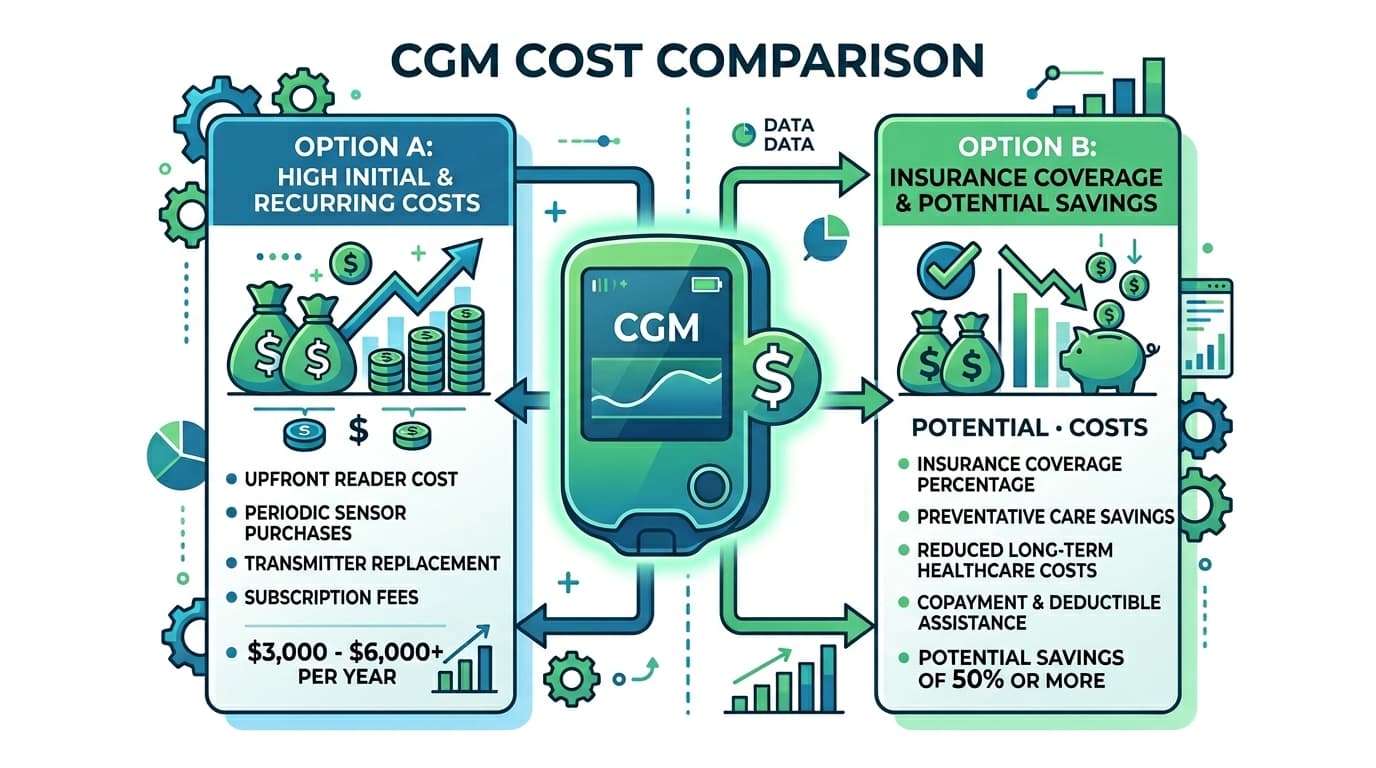
The true cost of a CGM is best understood on an annual basis because sensor wear time differences affect how many sensors you consume per year. Annual cost accounts for total sensor replacements, transmitter purchases (if separate), and any subscription or service fees over 12 months — eliminating the misleading variability of monthly snapshots that ignore bulk discounts and insurance deductible timing.
The FreeStyle Libre 3 Plus with commercial insurance costs $180-360/year — approximately 24 sensors per year at $15-30 per copay per 2-sensor box — making it the most affordable annual CGM option for insured patients. The Dexcom G7 with insurance runs $240-480/year, slightly higher because Dexcom copays tend to be $10-20 more per fill than Abbott's. Without insurance, the Dexcom G7 costs $3,000-4,200/year, the most expensive annual cost for any wearable CGM on the market. The Eversense 365 without insurance costs $2,000-5,000/year — but this includes only 1 sensor implantation procedure and 1 annual removal/reinsertion, which some patients prefer despite the higher upfront cost.
Over-the-counter devices fall in a predictable middle range: $588-1,188/year at $49-99/month, with no insurance variability because OTC pricing is fixed regardless of coverage status. Subscription services span the widest range at $588-4,788/yeardepending on the tier — January AI's annual plan at $49/month reaches $588/year, while Nutrisense's month-to-month premium tier at $399/month totals $4,788/year.
The single largest cost determinant is insurance status — the same Dexcom G7 costs $240/year with good insurance versus $4,200/year without it. This 17x cost multiplier is unique to the U.S. healthcare system and explains why OTC CGMs found an immediate market despite offering fewer features than prescription devices. A 2025 analysis by the Kaiser Family Foundation found that 28% of adults with prediabetes lack adequate insurance coverage for CGM devices, representing approximately 26.9 million Americans for whom OTC pricing is the only viable access point. For device-specific annual cost breakdowns, see the Dexcom cost guide and FreeStyle Libre cost guide.
Hidden Costs: Transmitters, Receivers, and Replacement Sensors
Beyond sensor costs, some CGM systems carry additional hardware expenses that do not appear in headline pricing. A transmitter is the electronic component that converts the sensor's raw signal into a digital glucose reading and broadcasts it via Bluetooth to a paired device. The Dexcom G7 integrates the transmitter into each disposable sensor pod, so there is no separate transmitter purchase — the $250-350/month retail price covers everything. The Eversense system, however, requires a separate transmitter costing $400-600 that sits on the skin above the implanted sensor and must be charged daily via a magnetic charging dock. This transmitter lasts approximately 1 year before replacement.
Abbott FreeStyle Libre systems are fully self-contained — no separate transmitter or receiver purchase is needed. The sensor contains all electronics in a single disposable unit. For all CGM brands, sensors that fail before their rated wear time (7, 10, 14, or 15 days) may not be immediately covered by insurance for replacement. Both Dexcom and Abbott maintain free replacement programs: Dexcom replaces defective sensors within 24-48 hours via their support line, and Abbott's customer service ships replacements within 3-5 business days. A 2024 Dexcom technical report indicated that 2.3% of G7 sensors fail before their rated 10-day wear time, triggering the replacement process.
Optional receiver devices (standalone screens that display glucose without a smartphone) cost $100-200 and are available from Dexcom and Medtronic. Most users rely on their smartphone and do not purchase a receiver, but they remain important for pediatric patients, elderly users without smartphones, and backup use during phone outages. For a full breakdown of all ancillary CGM costs, see the CGM insurance coverage guide.
HSA, FSA, and Tax Deductions for CGM Purchases
All prescription CGMs qualify as eligible medical expenses for Health Savings Accounts (HSA) and Flexible Spending Accounts (FSA). An HSA is a tax-advantaged savings account available to individuals enrolled in a high-deductible health plan (HDHP) that allows pre-tax contributions, tax-free growth, and tax-free withdrawals for qualified medical expenses. An FSAis an employer-sponsored pre-tax account with a "use it or lose it" annual limit ($3,200 in 2026). Both accounts accept CGM sensors, transmitters, receivers, and related supplies as eligible expenses.
OTC CGMs were added to the IRS eligible expense list in 2024 following their FDA clearance as glucose monitors. This means Dexcom Stelo, Abbott Lingo, and Abbott Libre Rio purchases can be reimbursed from pre-tax HSA/FSA funds — effectively reducing their cost by 22-37% depending on your marginal tax rate. A consumer in the 24% federal bracket with 5% state tax saves $171 on a $588/year Lingo subscription by paying with HSA dollars instead of after-tax income. For high-income earners in the 37% federal bracket, the same $588 annual spend is effectively reduced to $370 in pre-tax cost.
Additionally, total unreimbursed medical expenses exceeding 7.5% of adjusted gross income (AGI) can be itemized as a federal tax deduction under IRC Section 213(d). This threshold benefits uninsured CGM users spending $3,000+/year on devices — a person with $60,000 AGI who spends $4,200/year on Dexcom G7 out of pocket can deduct the amount exceeding $4,500 (7.5% of AGI), meaning the deduction is available only if total medical expenses exceed that floor. Combining HSA contributions with the medical expense deduction is not permitted for the same expense, so users should calculate which approach yields the greater tax benefit. For more on reducing CGM costs, see the CGM discount and savings programs guide.