
CGM Brands and Manufacturers Compared: Complete 2026 Guide
Five companies manufacture every continuous glucose monitor available worldwide in 2026. Dexcom and Abbott dominate the consumer CGM market with a combined 85%+ share of US prescriptions, while Medtronic focuses on integrated insulin pump systems and Senseonics offers the only implantable glucose sensor. A growing group of emerging manufacturers — including SIBIONICS and Biolinq — are developing next-generation sensors that aim to reduce cost and eliminate needle-based insertion.
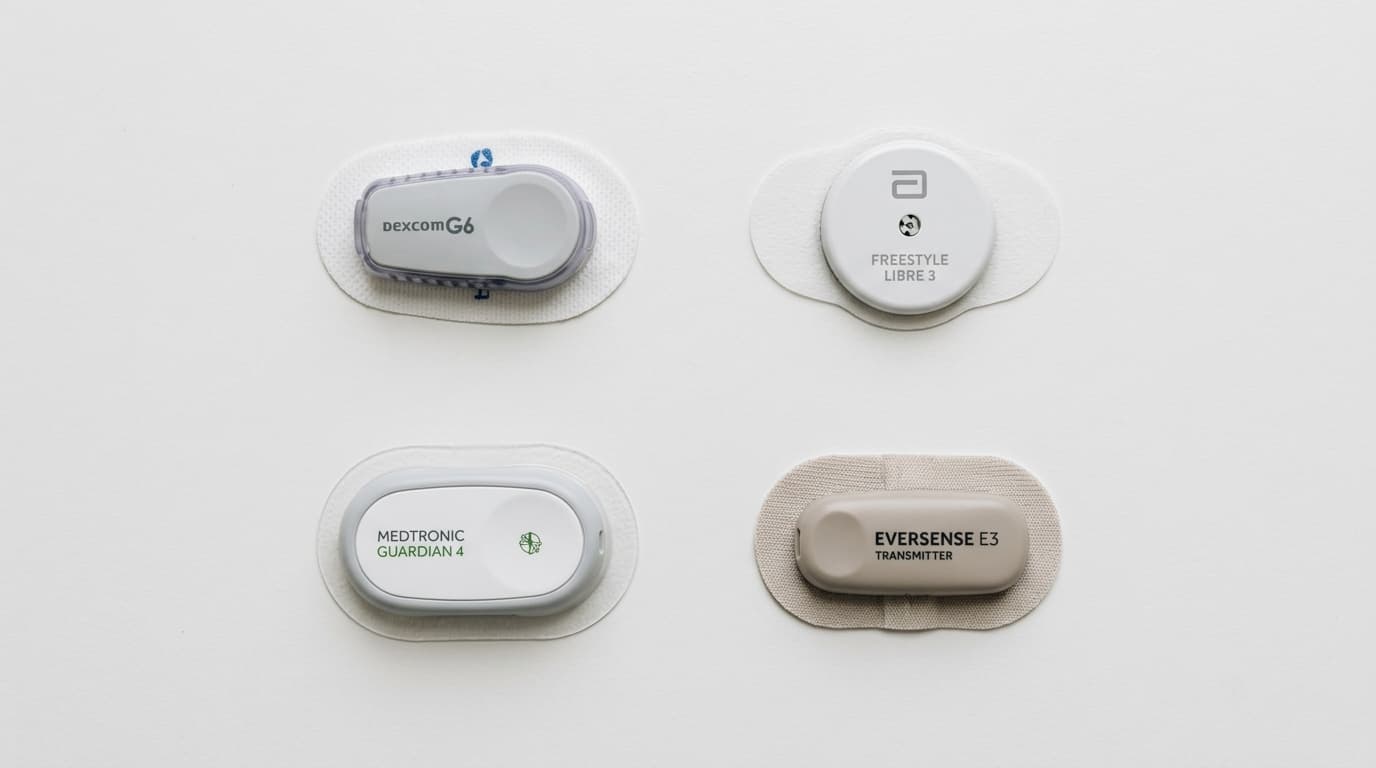
Each manufacturer has carved a distinct position in the continuous glucose monitoring market. Dexcom leads in real-time CGM accuracy and insulin pump integration, with the G7 serving as the sensor component in 3 major closed-loop insulin delivery systems. Abbott leads in unit volume and affordability, with the FreeStyle Libre family selling over 6 million sensors worldwide and maintaining the lowest prescription CGM price point. Medtronic is the only company that manufactures both the CGM sensor and the insulin pump as a single integrated system. Senseonics is the only company producing an implantable sensor, with the Eversense 365 offering an unprecedented 1-year sensor life.
The competitive dynamics shifted in 2024 when both Dexcom and Abbott launched over-the-counter CGM biosensors — the Stelo and Lingo respectively — that require no prescription. This opened the CGM market to an estimated 96 million Americans with prediabetes and a growing population seeking metabolic health optimization. Below, you will find each brand's complete product lineup, company background, and links to individual product reviews.
All CGM Manufacturers
Dexcom
Dexcom, Inc.
Dexcom is the leading dedicated CGM manufacturer in the United States, producing real-time continuous glucose monitors for people with diabetes and, more recently, over-the-counter biosensors for general wellness. Dexcom holds 3 FDA-cleared CGM product lines and supplies sensors to major insulin pump manufacturers for integrated closed-loop systems.
View all Dexcom CGM products →
Abbott
Abbott Laboratories
Abbott Laboratories manufactures the FreeStyle Libre family of continuous glucose monitors, the best-selling CGM line worldwide with over 6 million users across 60+ countries. Abbott pioneered the affordable flash glucose monitoring category with the original Libre sensor in 2017 and has since expanded into real-time CGM and over-the-counter biosensors.
View all Abbott CGM products →
Medtronic
Medtronic plc
Medtronic is the world's largest medical device company and the only manufacturer that produces both insulin pumps and CGM sensors as an integrated system. The Guardian sensor line is designed primarily for use with Medtronic MiniMed insulin pump systems to enable automated insulin delivery, though sensors can also be used standalone.
View all Medtronic CGM products →
Senseonics
Senseonics Holdings, Inc.
Senseonics manufactures the only implantable continuous glucose monitor on the market — the Eversense system. Unlike adhesive-patch CGMs, the Eversense sensor is inserted under the skin by a healthcare provider and measures glucose using fluorescence technology for up to 1 year. Senseonics targets patients who want to eliminate frequent sensor changes and adhesive-related skin issues.
View all Senseonics CGM products →
Emerging Brands
Emerging CGM Manufacturers
Several new companies are entering the continuous glucose monitoring market with novel sensor technologies. SIBIONICS (Shenzhen, China) has launched a 14-day CGM in select international markets, while Biolinq (San Diego, USA) is developing a minimally invasive on-skin biosensor that eliminates needle-based insertion entirely. These emerging players aim to expand CGM access with lower costs and less invasive designs.
View all Emerging Brands CGM products →
All CGM Products: Complete Specification Comparison
Every rated continuous glucose monitor from all manufacturers, sorted by GlucoseIntel rating.
| Product | MARD | Wear Time | Type | Rx? | With Insurance | Without Insurance | Medicare | Rating |
|---|---|---|---|---|---|---|---|---|
| Dexcom G7 | 8.2% | 10 days | Real time CGM | Yes | $20–$40 per month | $250–$350 per month | ✓ | 4.8 |
| Dexcom G7 15-Day | 8.2% | 15 days | Real time CGM | Yes | $20–$40 per month | $250–$350 per month | ✓ | 4.7 |
| FreeStyle Libre 3 Plus | 7.9% | 15 days | Real time CGM | Yes | $15–$30 per month | $75–$150 per month | ✓ | 4.7 |
| Eversense 365 | 8.5% | 365 days | Real time CGM | Yes | $150–$350 per month (amortized including implant procedure) | $2,000–$5,000 per annual sensor cycle | — | 4.6 |
| Eversense E3 | 8.5% | 180 days | Real time CGM | Yes | $200–$400 per month (amortized including implant procedure) | $1,000–$3,000 per 6-month sensor cycle | — | 4.5 |
| FreeStyle Libre 2 | 9.2% | 14 days | Flash glucose monitoring (scan based with optional alarms) | Yes | $15–$30 per month | $75–$150 per month | ✓ | 4.4 |
| Dexcom Stelo | 9% | 15 days | Real time CGM | No | N/A — OTC product not covered by insurance | $49–$99 per month | — | 4.3 |
| Abbott Lingo | 9% | 14 days | Real time CGM | No | N/A — OTC product not covered by insurance | $49 per month | — | 4.2 |
| Medtronic Guardian 4 | 8.7% | 7 days | Real time CGM | Yes | $30–$50 per month | $200–$300 per month | ✓ | 4.2 |
| Abbott Libre Rio | 9% | 14 days | Real time CGM | No | N/A — OTC product not covered by insurance | $49 per month | — | 4.1 |
| SIBIONICS CGM | 9% | 14 days | Real time CGM | No | N/A — not yet available in US insurance networks | $30–$60 per month (international pricing) | — | 3.8 |
CGM Market Share: Dexcom vs Abbott vs Medtronic in 2026
Two companies control the continuous glucose monitor market. Dexcom and Abbott hold approximately 85% of global CGM revenue in 2026, a dominance built over two decades of sensor technology development, clinical trial investment, and insurance formulary negotiation. The remaining 15% is split between Medtronic (approximately 12%) and Senseonics (under 2%), with emerging manufacturers accounting for less than 1% of worldwide sales.
Dexcom leads in the U.S. insulin-dependent segment with an estimated 52% share of domestic prescription CGM revenue. The G7 platform serves as the sensor component in 3 major closed-loop insulin delivery systems: the Omnipod 5 (Insulet), the t:slim X2 with Control-IQ (Tandem Diabetes), and the upcoming Tidepool Loop (Tidepool). This pump integration ecosystem creates significant switching costs — a patient whose insulin pump is calibrated to Dexcom glucose data faces clinical disruption if they move to a competing sensor. Dexcom reported $4.03 billion in 2025 revenue, a 19% increase year-over-year, with the Stelo OTC device contributing an estimated $280 million in its first full year.
Abbott leads in international markets and the emerging OTC category with a broader product range — 5 current-generation devices versus Dexcom's 3. The FreeStyle Libre family has shipped over 6 billion sensor hoursof glucose data globally, and Abbott maintains the lowest price point in the prescription CGM market. Abbott's 2025 CGM revenue reached $6.3 billion worldwide, though a significant portion comes from European and emerging markets where the Libre platform holds 60-70% share. The Lingo OTC device launched in 2024 and competes directly with Dexcom Stelo at the $49/month price point.
Medtronic holds a smaller CGM share but dominates the closed-loop insulin pump market where its Guardian 4 sensor integrates exclusively with the MiniMed 780G system. Unlike Dexcom, which sells its CGM separately and partners with multiple pump manufacturers, Medtronic bundles sensor and pump as a single ecosystem. This strategy limits Medtronic's CGM addressable market to its own pump users (approximately 800,000 patients worldwide) but creates the tightest hardware integration of any CGM-pump combination. Senseonics occupies the implantable nichewith under 2% market share but zero direct competitors — no other company manufactures a long-term implantable glucose sensor. The Eversense 365's 1-year sensor life appeals to patients who find frequent sensor changes burdensome or who experience adhesive irritation from disposable sensors.
How CGM Manufacturers Differentiate: Technology, Pricing, and Ecosystem Strategy
Each CGM manufacturer has built a distinct competitive strategy around technology choices, pricing models, and ecosystem partnerships that create measurable differences for the end user. Understanding these strategies explains why certain devices are better suited to specific patient populations — and why switching between brands involves more than swapping one sensor for another.
Dexcom's strategy centers on premium accuracy and pump integration. The G7 achieves 8.2% MARD — the second-lowest of any prescription CGM — and supports real-time data sharing with 3 insulin pump platforms. Dexcom invests heavily in alert algorithms: the G7's predictive urgent low alert fires 20 minutes beforeprojected hypoglycemia, giving insulin pump systems time to suspend basal delivery automatically. The trade-off is price — at $299/month without insurance, the G7 is the most expensive disposable CGM on the market. Dexcom's OTC entry (Stelo) is positioned as a premium wellness device at $89-99/month for the enhanced plan, compared to Abbott Lingo's flat $49/month.
Abbott competes on cost breadth and product range. The FreeStyle Libre ecosystem spans 5 devices from the $49/month Lingo (OTC wellness) to the Libre 3 Plus (7.9% MARD, the most accurate CGM available). Abbott's pricing advantage is significant: the Libre 3 costs approximately $75/month without insurance versus $299 for the Dexcom G7 and $350 for the Eversense E3 transmitter. Abbott achieves lower manufacturing costs through a simplified factory-calibrated sensor design that eliminates the fingerstick calibration requirement. The limitation is pump integration — as of 2026, no Abbott CGM integrates with a commercial insulin pump in the United States, though the Libre 3 Plus has CE marking for pump integration in Europe.
Medtronic ties CGM performance to its insulin pump ecosystem. The Guardian 4 sensor is not sold as a standalone CGM — it is available only to MiniMed 780G pump users, making it the only CGM that requires a specific insulin pump for purchase. This creates the tightest sensor-pump calibration of any system, with glucose data flowing directly to the pump's algorithm every 5 minutes for automated insulin adjustments. Senseonics offers the only implantable option for patients who want minimal sensor changes. The Eversense 365 requires a 10-minute in-office insertion procedure performed by a trained healthcare provider, after which the sensor operates for 365 days with 8.5% MARD. The daily transmitter is removable — users can take it off for swimming, contact sports, or MRI scans and reattach it without losing the implanted sensor. No disposable CGM offers this flexibility.
Emerging CGM Brands and What to Watch
The continuous glucose monitor market is attracting new manufacturers who aim to reduce cost, eliminate needle-based insertion, or serve populations underserved by the 4 established brands. SIBIONICS (Shenzhen, China) launched a 14-day CGM in European and Asian markets at approximately $30/month — less than half the price of the cheapest comparable device from Abbott or Dexcom. The SIBIONICS GS1 has not received FDA clearance and is not available in the United States, but its aggressive pricing signals the cost reduction potential of next-generation manufacturing.
Biolinq (San Diego, California) is developing a non-invasive CGM that sits on the skin surface without a subcutaneous filament. The Biolinq sensor uses a microneedle array that penetrates only the outermost layer of skin (less than 0.5 mm deep compared to 5-7 mm for traditional CGM filaments), measuring glucose from dermal interstitial fluid rather than subcutaneous tissue. Biolinq raised $116 million in Series C funding in 2023 and has published pilot accuracy data showing 12.3% MARD — not yet competitive with established devices but sufficient for wellness applications. Other emerging entrants include Know Labs (non-invasive spectroscopy-based approach) and Glucotrack (implantable multi-sensor platform). None of these companies have achieved significant U.S. market penetration yet, and investors should note that the FDA clearance timeline for novel CGM technologies typically spans 3 to 5 years from first clinical trial to market authorization. GlucoseIntel will add full product pages for any emerging device that receives FDA clearance or CE marking.