
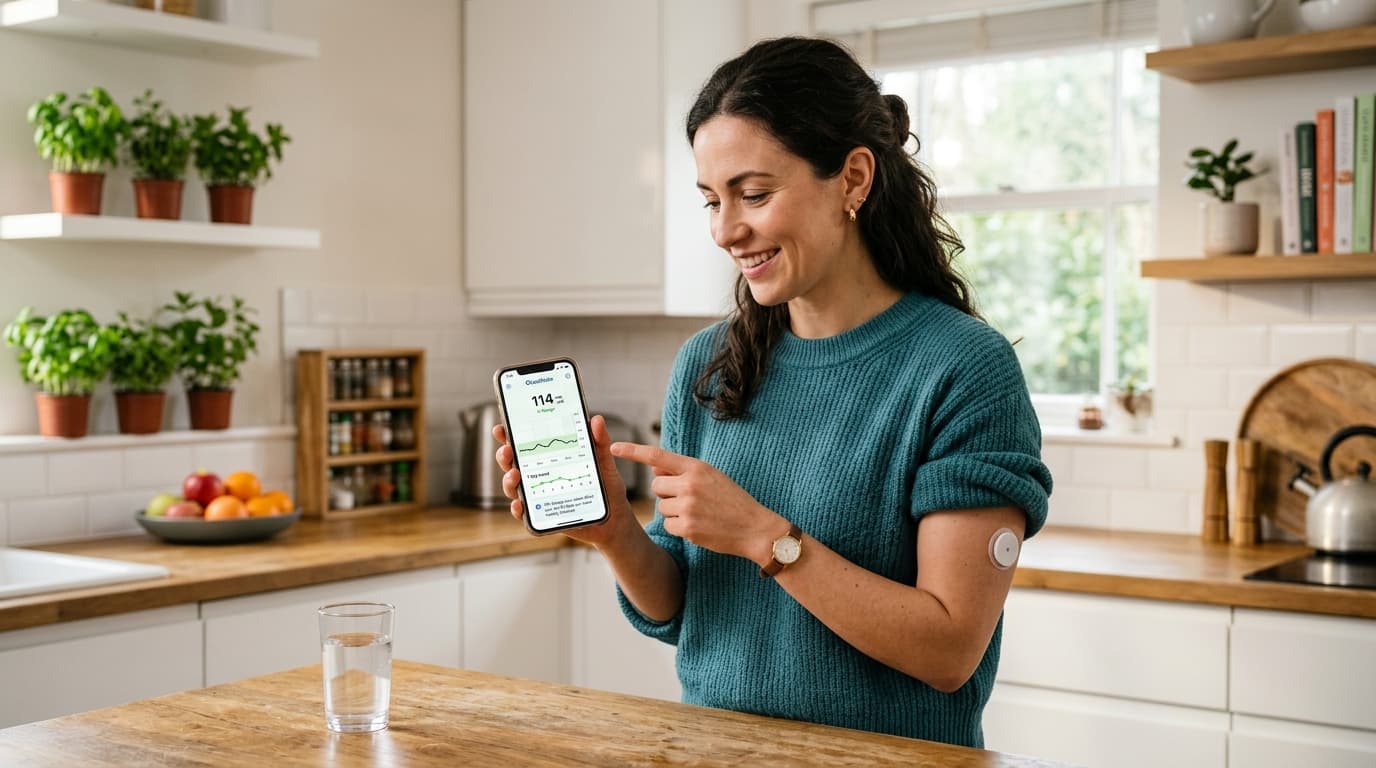
Jessie Inchauspé, known as the Glucose Goddess, has sold over 5 million copies of her books promoting simple "glucose hacks" that flatten blood sugar curves without eliminating carbohydrates. Her 3 core strategies—vinegar before meals, eating foods in a specific order, and moving after eating—are rooted in published research but rarely tested with continuous glucose monitors in real-world conditions. This article puts all 3 hacks to the CGM test.
Hack 1: Vinegar Before Meals
The claim: drinking 1 tablespoon of apple cider vinegar diluted in water 10-20 minutes before a carbohydrate-rich meal reduces the post-meal glucose spike by up to 30 percent. The mechanism is acetic acid's ability to slow gastric emptying and inhibit the enzyme alpha-amylase, which breaks down starch.
**The research supports this.** A 2004 study in Diabetes Care found that vinegar consumed before a high-glycemic meal reduced the post-meal glucose spike by 34 percent in insulin-resistant subjects and 19 percent in healthy controls. A 2017 meta-analysis in the European Journal of Clinical Nutrition pooled 11 trials and confirmed a statistically significant reduction in post-meal glucose following acetic acid ingestion.
**CGM test results:** The standard test meal was white rice with teriyaki sauce (estimated 65 grams of carbohydrate). Without vinegar, the meal produced a peak of 172 mg/dL (83 mg/dL above fasting baseline of 89 mg/dL). With 1 tablespoon of apple cider vinegar in 8 ounces of water consumed 15 minutes before the same meal, the peak dropped to 141 mg/dL (52 mg/dL above baseline). **The vinegar hack reduced the spike by 31 mg/dL, a 37 percent reduction.** The glucose curve also returned to baseline 25 minutes faster.
Verdict: **The vinegar hack works, and the CGM data closely matches the published research.** The effect is most pronounced with high-glycemic meals and diminishes with meals that already contain significant protein and fat.
Hack 2: Food Order (Vegetables and Protein First)
The claim: eating vegetables first, then protein and fat, then carbohydrates—in that specific order within the same meal—reduces the glucose spike by 30-70 percent compared to eating carbohydrates first.
**The research supports this, with caveats.** A landmark 2015 study in Diabetes Care by Shukla et al. found that eating protein and vegetables before carbohydrates reduced the post-meal glucose peak by 29 percent and the post-meal insulin response by 37 percent in patients with type 2 diabetes. A 2020 follow-up in BMJ Open Diabetes Research confirmed the effect in people without diabetes, though the magnitude was smaller (15-20 percent reduction).
**CGM test results:** The test meal was a complete dinner of grilled chicken breast, roasted broccoli, and white rice. Eaten in the "wrong" order (rice first, then chicken and broccoli), the meal peaked at 158 mg/dL. Eaten in the "right" order (broccoli first, then chicken, then rice 15 minutes later), the same meal peaked at 129 mg/dL. **The food order hack reduced the spike by 29 mg/dL, an 18 percent reduction.** The glucose curve was also 20 minutes narrower, meaning blood sugar returned to baseline faster.
Verdict: **Food order works, though the 30-70 percent reduction Inchauspé sometimes cites applies primarily to diabetic populations.** For metabolically healthy individuals, expect a 15-25 percent reduction—still meaningful and entirely free.
Hack 3: Movement After Eating
The claim: a 10-minute walk (or any light movement) within 30-60 minutes after a meal reduces the glucose spike by diverting blood glucose into active muscles.
**The research strongly supports this.** A 2022 meta-analysis in Sports Medicine reviewed 51 studies and concluded that light-intensity walking after meals reduced post-meal glucose peaks by an average of 17 percent. The optimal window is 15-45 minutes after the first bite, when glucose is actively rising. Walking for as little as 2-5 minutes produced measurable reductions, though 10-15 minutes was more effective.
**CGM test results:** After a standard pasta dinner (80 grams of carbohydrate), sitting produced a peak of 169 mg/dL. After an identical pasta dinner followed by a 15-minute walk at a comfortable pace starting 20 minutes after the first bite, the peak was 138 mg/dL. **The post-meal walk reduced the spike by 31 mg/dL, an 18 percent reduction.** The glucose curve was also visibly smoother, without the sharp spike-and-crash pattern seen in the sedentary test.
Verdict: **Post-meal walking works consistently and reliably.** It is the simplest of the 3 hacks and requires no planning or special ingredients.
All Three Hacks Combined
The final test combined all 3 strategies: vinegar 15 minutes before the meal, food order (vegetables, then protein, then carbohydrates), and a 15-minute walk after eating. The test meal was a restaurant-style burrito bowl (rice, beans, chicken, vegetables, guacamole—approximately 70 grams of carbohydrate).
Without hacks, the burrito bowl peaked at 163 mg/dL. With all 3 hacks applied, the peak was 121 mg/dL. **The combined approach reduced the spike by 42 mg/dL, a 26 percent reduction, keeping glucose entirely below 140 mg/dL—the threshold most CGM wellness services use for "optimal."**
The Limitations
The Glucose Goddess method is not a substitute for medical treatment of diabetes. Vinegar does not replace metformin; walking does not replace insulin. The hacks are most effective for metabolically healthy people and those with prediabetes who want to reduce glucose variability and potentially improve insulin sensitivity over time.
Additionally, the magnitude of the effect varies by individual. The personalized nutrition research from the Weizmann Institute (Cell, 2015) showed that glucose responses to identical foods can differ by up to 60 percent between individuals due to microbiome composition. A CGM is the only way to measure whether these hacks work for your specific biology—which is precisely why Inchauspé recommends wearing one. For comparing OTC sensor options, our Dexcom Stelo vs. Abbott Lingo analysis covers pricing, accuracy, and app features.