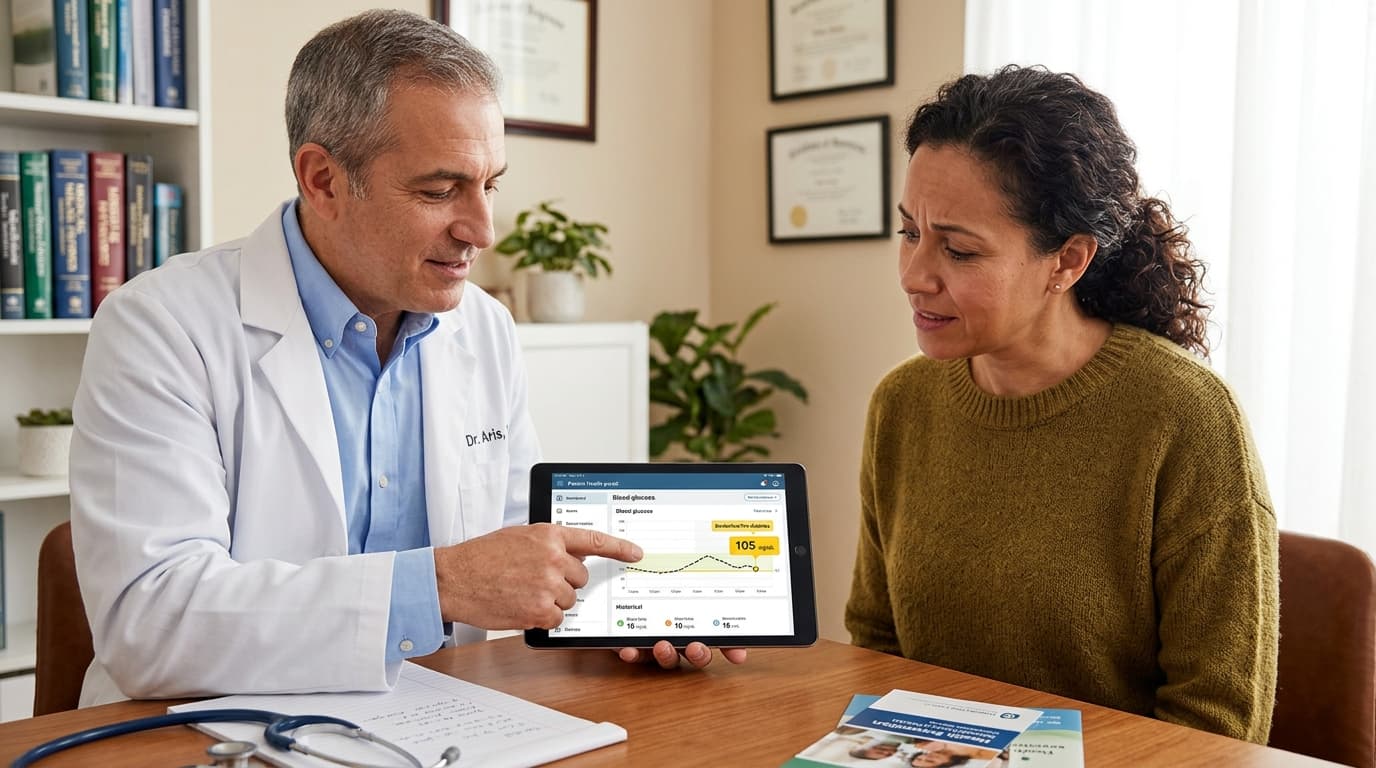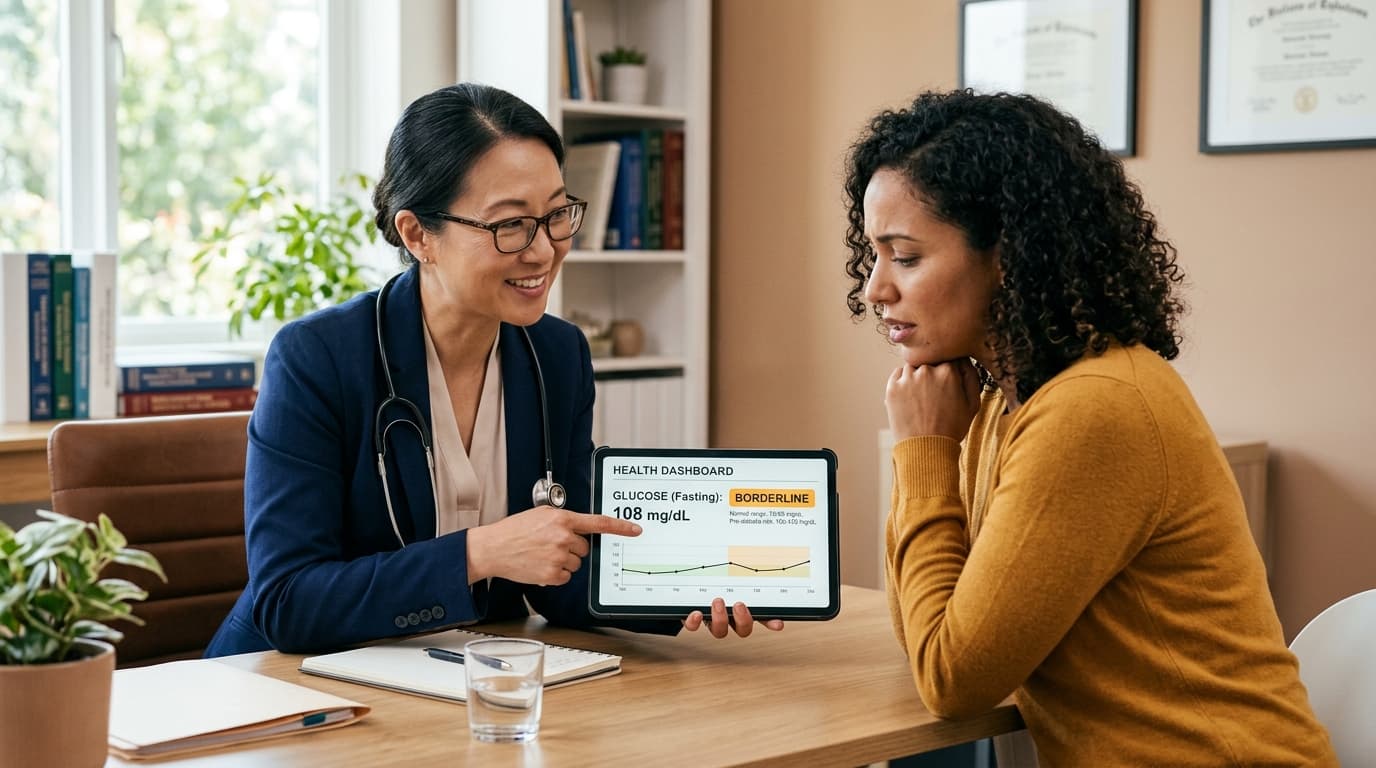
The Centers for Disease Control and Prevention estimates that 96 million American adults—more than 1 in 3—have prediabetes. Of those, 80 percent do not know they have it. Prediabetes is defined as a fasting glucose of 100-125 mg/dL or an A1C of 5.7-6.4 percent, and without intervention, 15-30 percent of people with prediabetes will develop type 2 diabetes within 5 years. A continuous glucose monitor can detect the glucose abnormalities that define prediabetes months or years before a standard blood test raises a flag.
Why Standard Tests Miss Early Glucose Problems
The two most common screening tests for prediabetes—fasting glucose and A1C—measure averages. A fasting glucose test captures a single snapshot first thing in the morning. An A1C test reflects the average glucose exposure of red blood cells over 2-3 months. Neither test reveals what happens after meals.
This matters because post-meal glucose spikes are often the earliest detectable sign of insulin resistance. A person with a normal fasting glucose of 92 mg/dL and a normal A1C of 5.4 percent can still experience post-meal glucose excursions to 180-200 mg/dL—values that would classify as prediabetic if captured by a glucose tolerance test, but are invisible to routine screening.
A continuous glucose monitor captures all 288 daily readings, including every post-meal spike, every overnight fluctuation, and every response to exercise and stress. It provides a complete metabolic picture that single-point blood tests simply cannot match.
What CGM Data Reveals in Prediabetes
When a person with undiagnosed prediabetes wears a CGM for the first time, several characteristic patterns emerge:
**Elevated post-meal peaks:** Glucose rises above 160 mg/dL after meals containing moderate carbohydrates (40-60 grams). In a metabolically healthy person, the same meal would produce a peak below 140 mg/dL.
**Delayed glucose clearance:** After a healthy person eats, glucose returns to baseline within 2 hours. In prediabetes, clearance takes 3-4 hours because insulin signaling is impaired. CGM graphs show a broader, more drawn-out post-meal curve.
**Increased glucose variability:** The coefficient of variation (CV) exceeds 20 percent, meaning glucose swings widely throughout the day. A healthy CV is below 20 percent; values above 36 percent are associated with increased hypoglycemic risk in people with diabetes.
**Elevated overnight baseline:** Instead of settling into the 70-90 mg/dL range overnight, fasting glucose remains between 95-120 mg/dL, reflecting persistent hepatic glucose output driven by insulin resistance.
**Exaggerated dawn phenomenon:** The early morning glucose rise—normally 10-20 mg/dL—can reach 30-40 mg/dL in people with insulin resistance, pushing fasting glucose at waking above 110 mg/dL.
OTC CGMs Open the Door for Undiagnosed Individuals
Before 2024, obtaining a CGM required a prescription, which meant a person had to see a doctor, receive a diagnosis, and navigate insurance approval. The introduction of over-the-counter CGMs—Dexcom Stelo and Abbott Lingo—removes every barrier except cost.
For the estimated 76 million Americans who have prediabetes but do not know it, OTC CGMs provide a self-directed screening tool. Two weeks of CGM data can reveal glucose patterns that would take years of annual blood work to detect. The cost—$49-$99 per month—is a fraction of the downstream healthcare expense of unmanaged prediabetes, which the American Diabetes Association estimates at $4,250 per person per year in direct medical costs.
Behavior Change Through Real-Time Data
The most powerful aspect of CGM use in prediabetes is the immediate feedback loop. Seeing a glucose spike to 185 mg/dL after a bagel creates a visceral motivation to try a different breakfast tomorrow. This real-time biofeedback mechanism is supported by research: a 2023 trial in Diabetes Care found that people with prediabetes who wore CGMs for 12 weeks reduced their average post-meal glucose by 22 mg/dL, increased their daily step count by 1,800 steps, and lost an average of 3.2 kg—all without formal dietary counseling.
The study's lead author noted that "the CGM served as a continuous behavioral nudge" that was more effective than periodic A1C test results at motivating lifestyle changes.
The Cost of Prevention vs. Treatment
The economic argument for CGM-based early detection is compelling. Managing type 2 diabetes costs an average of $9,601 per person per year in the United States (ADA, 2022 data). The total annual cost of diagnosed diabetes in America exceeds $412 billion.
In contrast, a 3-month CGM intervention for someone with prediabetes costs $150-$600 (depending on whether an OTC sensor or subscription service is used). If that intervention delays or prevents progression to type 2 diabetes—as the behavioral data suggests is possible—the return on investment is enormous: potentially $50,000-$100,000 in lifetime healthcare savings per person.
Continuous glucose monitoring will not single-handedly solve the prediabetes epidemic. But by making invisible glucose dysfunction visible, CGMs give 96 million Americans a tool to take action before a diagnosis that currently catches most people too late.