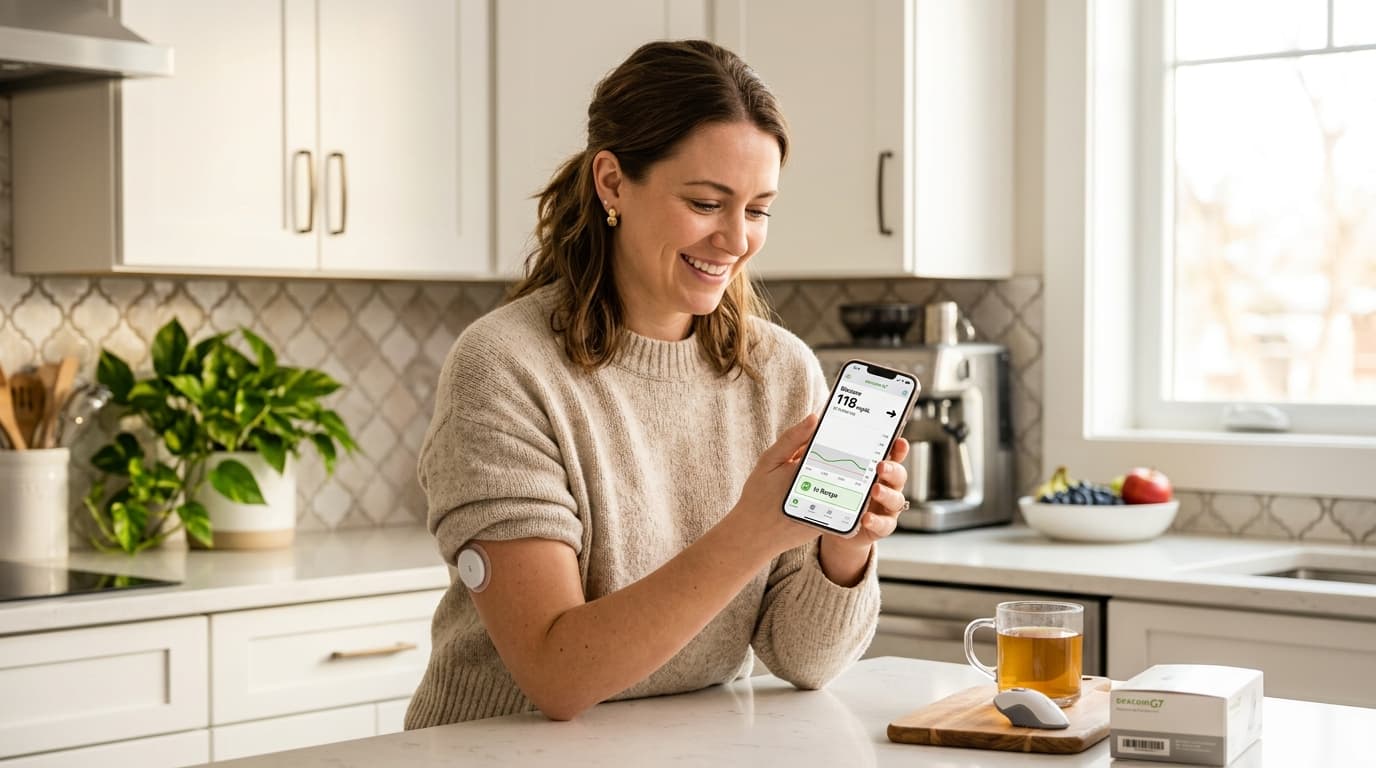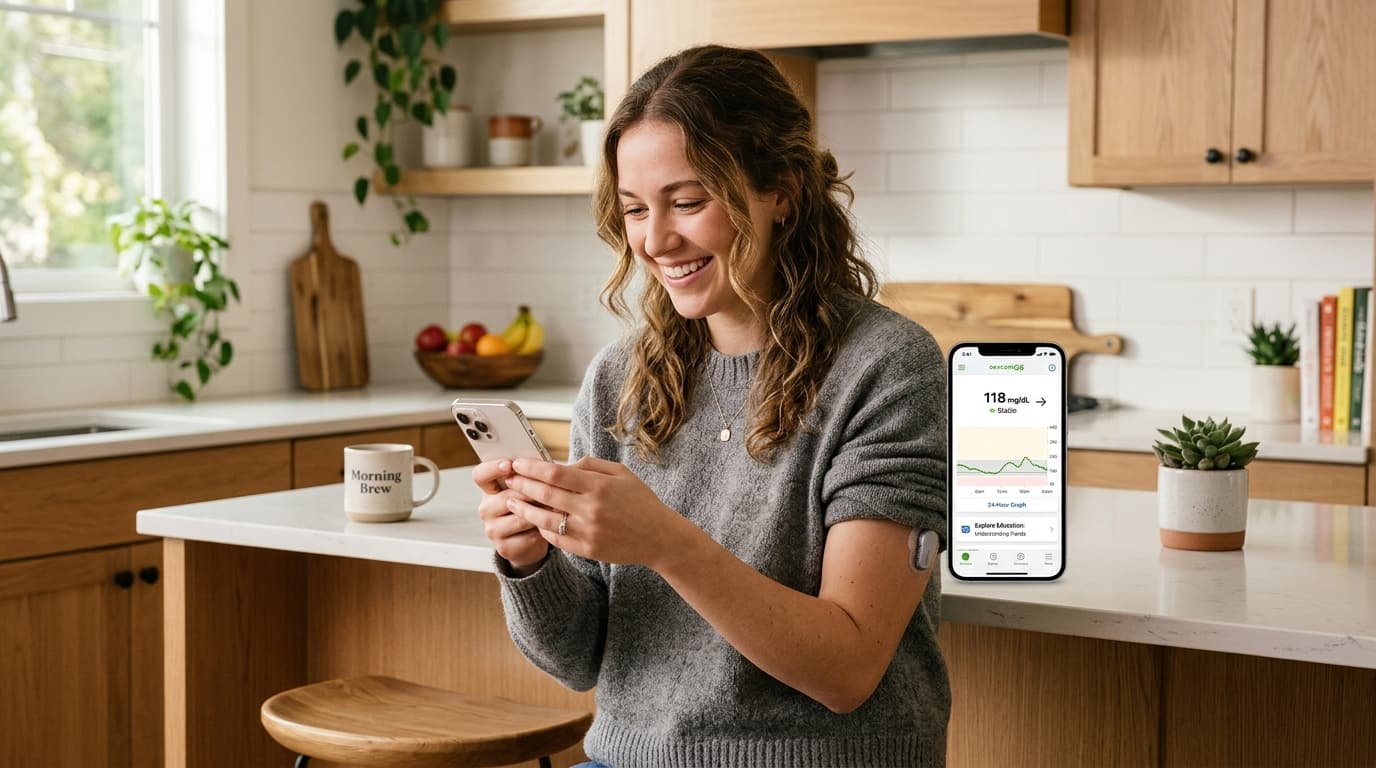
A continuous glucose monitor generates approximately 288 glucose readings per day—one every 5 minutes, 24 hours a day. That volume of data can feel overwhelming when you first start wearing a CGM sensor. This guide breaks down the key metrics, reports, and patterns so you can turn raw numbers into actionable insights.
What Your CGM Actually Measures
A CGM sensor sits in the interstitial fluid just beneath the skin and measures glucose concentration in that fluid, not directly in the blood. Interstitial glucose tracks blood glucose closely but with a 5-15 minute lag. This means the number on your phone at any given moment is a close approximation of your blood sugar, not an exact match to a fingerstick reading.
Most modern CGMs—including the Dexcom G7, Abbott Libre 3, and Medtronic Guardian 4—take a reading every 1-5 minutes and display a real-time value on a smartphone app or dedicated receiver.
The Ambulatory Glucose Profile (AGP)
The AGP report is the standardized format that healthcare providers use to review CGM data. It compresses 14 days of glucose readings into a single 24-hour graph. The report shows:
- **Median line (50th percentile):** Your typical glucose at each time of day. - **Interquartile range (25th-75th percentile):** The blue shaded band showing where your glucose falls most of the time. - **5th-95th percentile range:** The wider band capturing 90 percent of all readings, including outliers.
A "good" AGP has a narrow interquartile band (low variability) and a median line that stays between 70 and 180 mg/dL for people with diabetes, or 70 and 140 mg/dL for non-diabetic wellness users.
Time in Range: The Most Important Metric
Time in Range (TIR) measures the percentage of the day your glucose stays within a target zone. The international consensus guidelines define the following targets for people with type 1 or type 2 diabetes:
- **Target range (70-180 mg/dL):** Greater than 70 percent of the day - **Below range (<70 mg/dL):** Less than 4 percent of the day - **Significantly below range (<54 mg/dL):** Less than 1 percent of the day - **Above range (>180 mg/dL):** Less than 25 percent of the day - **Significantly above range (>250 mg/dL):** Less than 5 percent of the day
For non-diabetic adults using an OTC CGM, a more aggressive target of 70-140 mg/dL is commonly used by wellness services like Levels and Nutrisense. In clinical studies, healthy adults without diabetes spend approximately 96 percent of the day between 70 and 140 mg/dL.
Glucose Management Indicator (GMI)
GMI is an estimated A1C calculated from your average CGM glucose. The formula converts your mean glucose over 14 or more days into an equivalent A1C percentage. For example, a mean glucose of 154 mg/dL corresponds to a GMI of approximately 7.0 percent.
GMI is useful for tracking trends between lab visits, but it does not replace a laboratory A1C test. Individual red blood cell lifespans and other biological factors can cause GMI and lab A1C to diverge by up to 0.5 percentage points.
Trend Arrows: Real-Time Direction
Most CGMs display trend arrows alongside the current glucose value. These arrows indicate how fast glucose is changing:
- **Steady (→):** Glucose is changing less than 1 mg/dL per minute - **Slowly rising (↗) or falling (↘):** 1-2 mg/dL per minute - **Rapidly rising (↑↑) or falling (↓↓):** More than 2 mg/dL per minute
Trend arrows are especially important for insulin users because they indicate whether glucose is heading toward a high or low. A reading of 110 mg/dL with a double-down arrow means glucose could drop to 70 mg/dL within 20 minutes—a very different situation than 110 mg/dL with a steady arrow.
How to Read Your Glucose Graph
The daily glucose graph plots your readings on a timeline. Here are the patterns to look for:
**Post-meal spikes:** A healthy post-meal glucose peak is below 140 mg/dL and returns to baseline within 2-3 hours. Spikes above 160 mg/dL suggest the meal contained more rapidly-absorbed carbohydrates than your body can handle efficiently.
**Overnight baseline:** Fasting overnight glucose for non-diabetic adults typically ranges from 70-100 mg/dL. A gradual rise in the early morning hours (4-8 AM) is called the "dawn phenomenon" and results from natural cortisol and growth hormone secretion.
**Glucose variability:** Large swings—say, from 70 to 190 mg/dL and back multiple times per day—indicate high glycemic variability, which some researchers associate with increased cardiovascular risk independent of average glucose levels.
Getting Started
The single most valuable habit for a new CGM user is logging meals for the first 2 weeks. When you can overlay your food log against your glucose graph, patterns emerge quickly: you will see which foods spike you, which meals keep you stable, and how exercise and sleep affect your numbers. That data-driven awareness is the entire reason continuous glucose monitors have moved beyond the diabetes clinic and into mainstream wellness.