
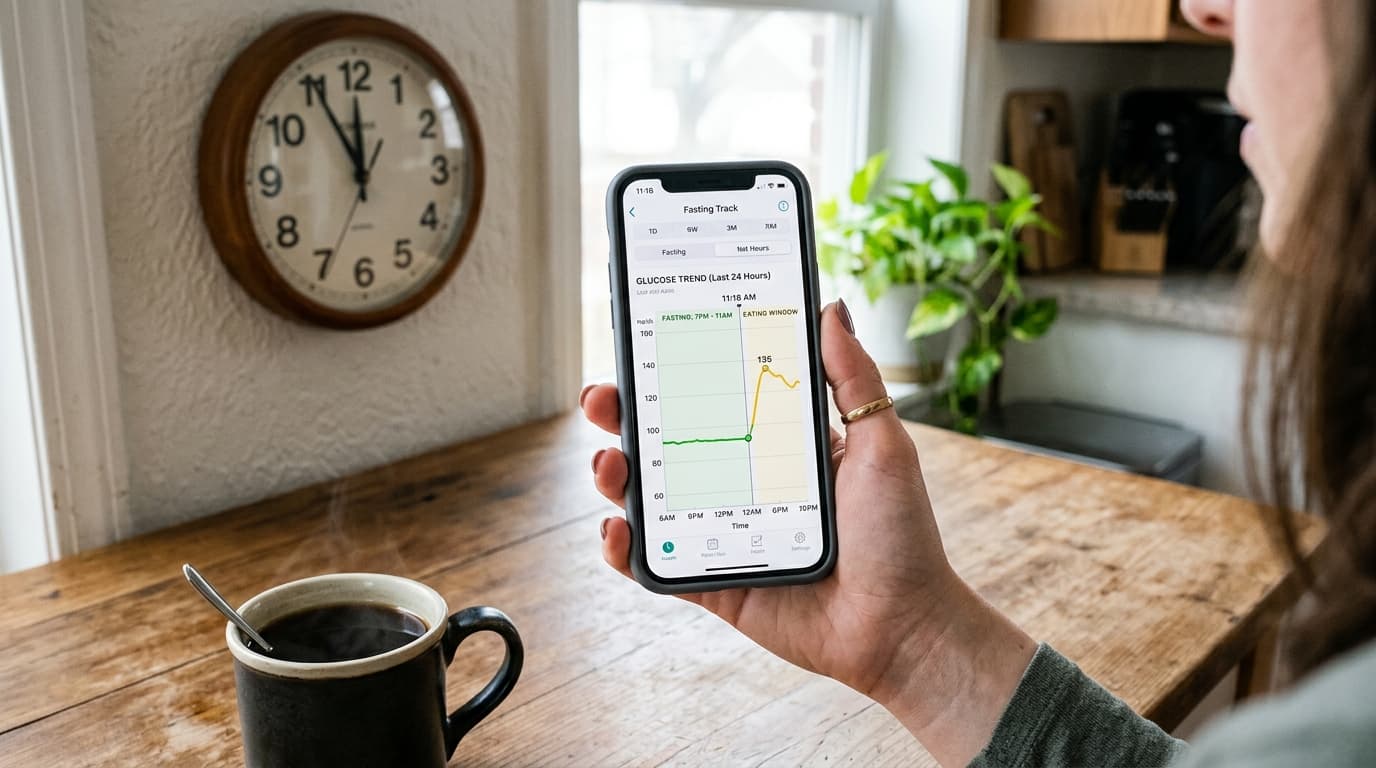
A 24-hour fast produces a distinctive glucose pattern on a continuous glucose monitor that reveals how the body transitions from fed-state glucose metabolism to fasting-state fat oxidation. This article tracks a complete 24-hour water-only fast using an Abbott FreeStyle Libre 3 sensor, documenting glucose readings every hour alongside the metabolic processes occurring at each stage.
Hour 0-4: Post-Absorptive Phase (6 PM — 10 PM)
The fast began immediately after a balanced dinner at 6:00 PM (grilled chicken, brown rice, roasted vegetables—approximately 60 grams of carbohydrate). Post-meal glucose peaked at 138 mg/dL at 7:15 PM and began its descent as insulin cleared the dietary glucose.
By 8:00 PM, glucose had returned to 104 mg/dL. By 10:00 PM, glucose stabilized at 92 mg/dL. During this phase, the body is still processing the last meal. Liver glycogen stores are full (approximately 80-100 grams), and insulin levels remain modestly elevated. The CGM trace shows a smooth downward slope—entirely unremarkable and identical to any post-dinner pattern.
Hour 4-12: Early Fasting / Overnight (10 PM — 6 AM)
Glucose entered the overnight fasting baseline at approximately 10:30 PM, settling into a narrow band of 82-88 mg/dL. During this phase, insulin levels drop to basal levels and glucagon begins to rise, signaling the liver to begin glycogenolysis—the breakdown of stored glycogen into glucose to maintain blood sugar.
**The glucose trace during this period is the flattest of the entire 24 hours.** Standard deviation over the 8-hour overnight window was just 3.1 mg/dL. The liver releases glucose at a precisely calibrated rate of approximately 2 mg/kg/minute to match the brain's constant glucose demand (120 grams per day).
At 5:00 AM, the dawn phenomenon appeared: glucose rose from 84 mg/dL to 97 mg/dL over 90 minutes. This morning cortisol-driven glucose release occurs regardless of whether a person has eaten dinner or not—it is a hormonal event, not a dietary one.
Hour 12-16: Mid-Fast / Morning (6 AM — 10 AM)
By 6:00 AM (12 hours fasted), glucose was 95 mg/dL—elevated slightly from the dawn phenomenon but still well within normal range. This is the point at which most intermittent fasting practitioners break their fast in a 16:8 protocol.
Between 8:00 and 10:00 AM, an interesting CGM pattern emerged: glucose dipped from 95 mg/dL to 88 mg/dL, then briefly rose to 96 mg/dL without any food intake. **These small oscillations (5-10 mg/dL) during extended fasting are caused by pulsatile glucagon secretion from the pancreas.** The liver responds to each glucagon pulse by releasing a small burst of glycogen-derived glucose, creating a gentle "saw-tooth" pattern on the CGM.
Hunger was moderate at this point. Energy levels were surprisingly stable—consistent with the observation that blood sugar during fasting does not drop precipitously in metabolically healthy people. The brain switches partially to ketone utilization, reducing its glucose demand.
Hour 16-20: Late Fasting / Glycogen Transition (10 AM — 2 PM)
At the 16-hour mark, glucose read 84 mg/dL. Liver glycogen stores were approximately 50 percent depleted based on published estimates from MRI spectroscopy studies (Rothman et al., Journal of Clinical Investigation, 1991). The body was now relying increasingly on gluconeogenesis—manufacturing new glucose from amino acids, lactate, and glycerol—rather than breaking down stored glycogen.
**The CGM revealed a subtle but measurable decline in average glucose during this window.** Glucose averaged 81 mg/dL between hours 16-20, compared to 87 mg/dL during hours 4-12. The decline of 6 mg/dL reflects the transition from glycogenolysis (efficient, large stores) to gluconeogenesis (slower, more metabolically costly).
Ketone production was likely accelerating at this point. Published research shows that blood beta-hydroxybutyrate levels rise above 0.5 mmol/L after 16-20 hours of fasting, crossing the threshold into mild nutritional ketosis. The CGM cannot measure ketones, but the glucose pattern is consistent with the metabolic transition.
Hour 20-24: Deep Fast (2 PM — 6 PM)
Glucose during the final 4 hours of the fast ranged from 74 to 82 mg/dL, with an average of 77 mg/dL. This was the lowest average glucose of the entire 24-hour period but was never close to hypoglycemia (below 70 mg/dL). At no point during the fast did the FreeStyle Libre 3 issue a low-glucose alert.
At 4:30 PM (hour 22.5), glucose dipped to 74 mg/dL—the single lowest reading of the fast. This brief dip lasted 15 minutes before gluconeogenesis restored glucose to 79 mg/dL. Subjective symptoms at this point included mild light-headedness when standing quickly (orthostatic), but no shakiness, sweating, or cognitive impairment.
**The key CGM insight from the deep fast: glucose regulation in a metabolically healthy person is remarkably robust.** The body maintained blood sugar within a 74-97 mg/dL range for 24 hours without any caloric intake—a testament to the precision of the glucagon-insulin counterregulatory system.
Breaking the Fast: The Re-Feed Glucose Response
The fast was broken at 6:00 PM with a moderate meal: scrambled eggs, avocado, sourdough toast, and a small portion of fruit (approximately 45 grams of carbohydrate, 25 grams of protein, 20 grams of fat).
Pre-meal glucose: 78 mg/dL. Post-meal peak: 142 mg/dL at 55 minutes—a spike of 64 mg/dL. On a non-fasting day, the same meal produced a spike of 44 mg/dL from a higher baseline of 95 mg/dL.
**The re-feed spike was 20 mg/dL larger than the non-fasting response.** This phenomenon, called "post-fast hyperglycemia," occurs because 24 hours of low insulin exposure transiently reduces the efficiency of insulin-stimulated glucose uptake. The effect resolves within 24-48 hours of resuming normal eating.
Lessons for CGM Users Interested in Fasting
**Metabolically healthy people maintain safe glucose levels throughout a 24-hour fast.** The concern that "blood sugar will crash" during fasting is not supported by CGM data in people without diabetes or insulin-dependent conditions.
**The dawn phenomenon occurs regardless of fasting status.** Morning glucose rises are hormonal, not dietary, and should not be interpreted as a reason to break the fast early.
**Break the fast with a balanced meal, not pure carbohydrate.** Including protein and fat in the re-feed meal moderates the post-fast glucose spike. For more on how intermittent fasting patterns appear on CGM data, see our detailed analysis of intermittent fasting and blood sugar.